venture capital lawyers
venture capital lawyers
We help companies, venture capital firms and family office investors across Southeast Asia with all types of funding rounds, including seed and angel rounds, VC financings, private equity investments, and pre-IPO rounds. Our capital raising work includes drafting and negotiating term sheets, convertible notes, subscription and shareholders’ agreements, venture debt documents and other standard investment documents, along with transaction mechanics (legal due diligence, approvals and closings).
We advised on over 80 Southeast Asia financing deals in 2020 alone. These deals ranged from small seed investments to significant series B and C financing rounds led by globally recognised VCs. This deal flow gives us great market knowledge of the latest investment trends in the region which we monitor in our Map of the Funding Terms.
agreeing terms
Because we see a large number of deals, we can provide useful behind the scenes input to companies as they negotiate headline terms with investors, including the investment amount, the pre-money valuation and whether the investment is to be tranched.
Once the big ticket items are agreed in principle, we help companies negotiate the detail of the term sheet. The key economic and control terms are agreed in the term sheet, making it the most important phase of an investment deal.
formal documents
The style and friendliness of investment documents varies widely depending on the type of investor.
We draft and negotiate all of the types of documents used by seed, angel, VC, corporate, venture debt, private equity and pre-IPO investors. We know the negotiating parameters that investors are likely to bring to the negotiation table and we share this knowledge with our clients.
We also promote better investment documentation and practices to founder and investor communities.
investors
We act for a number of venture capital funds, family offices and corporate venture teams on investments in Southeast Asian tech companies. We have dealt with virtually all of the professional tech investors active in the region.
"Kindrik Partners were invaluable in moving the deal forward as efficiently as possible by keeping the negotiations centred on the critical commercial points, and by providing insight as to what was common market practice in these areas."
patrick gentry, ceo, sprout solutions
venture capital resources
This is a simple term sheet for use when a startup is raising capital from seed investors in Southeast Asia. It sets out the terms agreed between the company and the investors prior to preparing the formal agreements. Generally in this type of capital raising the formal agreements will be a subscription agreement – see the template southeast asia seed subscription agreement – and a shareholders’ agreement – see the template southeast asia seed shareholders’ agreement. The term sheet is not legally binding (other than the confidentiality obligations in part B); it simply sets out the terms agreed in relation to an investment.
There are no standard terms that apply to investment by seed investors – these types of investments can often be relatively informal and may not always include the investor protection provisions required by professional investors on larger series A investment rounds. We recommend that you read our guides to raising seed capital in southeast asia.
using our templates
Use of a template by business users is free of charge and is subject to you agreeing to our template terms of use.

what this is
This note is a convertible instrument that is intended to be used by a startup to document a seed investment from a third party investor or a bridge financing from existing shareholders.
The terms of the note are substantially based on the keep-it-simple-security created by 500 Startups and include some of the investor friendly provisions typically included in convertible seed investments in the US and as adopted for other global markets.
how it works
This note anticipates that the investment amount is drawn down in one lump sum and is unsecured. The investment amount:
- automatically converts to equity on the date of a qualifying capital raise
- is repayable (potentially at a multiple of the outstanding amount) or convertible at the investor’s discretion on the occurrence of a liquidity event
- is repayable or convertible at the investor’s discretion at any time following maturity.
This note also anticipates that it may be one of a series of identical notes entered into as part of a seed investment round. In that case, some decisions that relate to the investment round as a whole are to be made by a majority of the investors, rather than by an individual investor.
related guides
- 8 key features of convertible notes in southeast asia
- raising capital for your startup: convertible notes vs equity
- raising seed capital in southeast asia: structure & terms
you might also like
We also have another popular variation of the convertible note – our SAFE convertible note template.
The terms of the note are substantially based on the simple agreement for future equity created by the US accelerator, Y-Combinator.
using our templates
Use of a template by business users is free of charge and is subject to you agreeing to our template terms of use.
This template cap table is intended for use when considering a potential equity investment in a company (whether from existing shareholders, external investors, or both). The template works when the number of new shares to be issued is calculated:
- based on a specific investment amount at a specific pre-money valuation of the company e.g. an aggregate investment of $500,000 at a pre-money valuation of $2m
- on a fully diluted basis i.e. all unexercised options (if any) are treated as existing shares in the company for the purpose of calculating the number of new shares to be issued
- no anti-dilution rights are triggered by the issue of the new shares
- all shares issued in consideration for the conversion of debt to equity are issued at a discount to the price per share paid by the cash investors. If all of the debt is converting at the same price per share paid by the cash investors please use our template investment capitalisation table for debt converting without a discount
- the investment is made on a fully diluted basis, i.e. if a new employee share option plan (ESOP) is established as part of the investment round, the dilutionary effect of the ESOP is borne entirely by the founders and any other existing shareholders, and not by the investors. This is the most common approach.
using our templates
Use of a template by business users is free of charge and is subject to you agreeing to our template terms of use.

If you are considering raising money for your startup in Southeast Asia, there are two main ways you can do it: either by giving away equity in exchange for money, or by using convertible notes. In this guide we explain how each approach works and the pros & cons of the different methods.
Other resources in our series on convertible notes:
- 8 key features of convertible notes in southeast asia
- KISS term sheet template (PDF & Word versions)
- KISS convertible note template (PDF & Word versions)
- SAFE convertible note template (PDF & Word versions)
what is a convertible note?
In simple terms, a convertible note is a loan that converts to equity when you do your next fundraising round – a qualifying capital raise. In other words, investors will loan money to a startup, and then rather than get their money back with interest, the investors will receive shares in the next round. Originally used more for bridging rounds, where money was given to make it to the next funding round, convertible notes are now very common in seed rounds.
There are two key features of a convertible note. One is that a convertible note will usually convert at a discounted price to the next round price. In other words, founders are trying to incentivise investors by saying, “if you invest in us today [when we’re a riskier bet], we’ll give you 20% off when it comes time to our Series A round”.
The second key feature is its valuation cap, which protects investors by putting a ceiling on the conversion price of the note and lets the investors share in any significant increase in valuation (that might have come as a result of their investment of money and resources).
types of convertible note
There are two main forms of note used in Southeast Asia: the KISS-style note used by 500 Startups, and the SAFE note based on the note developed by Y Combinator.
Under the KISS convertible note, the note is repayable on the maturity date (typically 18-24 months from the date of the convertible note) if it has not already converted to shares. The investor can also choose to be repaid the investment amount (or a multiple of the investment amount) on a liquidity event.
A SAFE note, on the other hand, is not repayable at the end of a fixed period, and the company must only repay the note if an insolvency event occurs, or if the investor chooses to be repaid on a liquidity event rather than convert their note. A SAFE is essentially a quasi-equity instrument, whereas as KISS is quasi-debt, because there is a contingent repayment obligation.
The KISS and the SAFE notes also differ in the ways that they can convert.
A KISS note converts:
- automatically when the company raises its next round (the qualifying capital raise);
- at the investor’s election when a liquidity event occurs (like the sale of the company); or
- at the investor’s election at the maturity date.
On the other hand, a SAFE note converts automatically when the company raises a qualifying capital raise, or if the investor so chooses on a liquidity event. The investor cannot force conversion after a fixed period.
There are also different types of SAFE notes, namely the pre-money SAFE and the newer post-money SAFE recently developed by Y Combinator. The difference between these is a substantial topic in and of itself – we recommend checking out some of the blog articles that others have written about it, like this one.
what is an equity investment?
Unlike a convertible note, under an equity investment, the investor receives shares in the company at the time of their investment. Where the investor is an institutional VC, those shares will typically be preference shares, which may carry the types of preferential rights we discuss in this guide.
pros and cons: benefits of convertible notes
From a founder’s perspective, the biggest benefit of convertible notes over an equity financing is speed. The note is generally a single document with simpler terms to negotiate, and without lots of conditions, representations and warranties.
In addition, the KISS and other most convertible notes are designed to be executed by individual investors, so it is possible to receive funds without closing with all investors simultaneously – a ‘rolling close’.
Here are some other benefits to using convertible notes:
- they postpone the difficult discussion about the company’s valuation. It is hard to value startups early on. Deferring the valuation until a larger equity round is raised is one way to address this (this doesn’t apply if you are using a post-money SAFE).
- they have a lower cost to execute. Convertible notes are simple and flexible. It involves a single document, whereas even small equity investments can involve a subscription agreement, shareholders’ agreement and a new constitution.
- there are fewer representations and warranties. Subscription agreements often include multiple representations and warranties which are inappropriate for an early stage startup. A convertible note generally includes only a handful of very focused warranties.
- they concede much less control. Noteholders typically receive little (if any) control over the company, e.g. no veto or director appointment rights. This works well with the need for startups to pivot and to raise the next round of funding without investor interference
- less administrative burden. The fewer shareholders you have, the less shareholder notices and other company secretarial formalities you have to deal with.
pros and cons: disadvantages of convertible notes
However, there are some downsides to convertible notes from a founder’s point of view:
- KISS convertible notes are debt. The clock starts running towards repayment on the maturity date. If you have not completed a qualifying capital raise by that date, the debt needs to be repaid. While it is uncommon for investors to enforce that right and force the winding up the company if the debt cannot be repaid, you may have to renegotiate some form of refinancing with note holders at which point you will be seriously on the back foot. However, this does not apply to SAFE notes which are quasi-equity.
- preference shares generally issued on conversion. Most convertible notes convert into the class of shares issued to the investors on the next round of financing. In Southeast Asia, this means preference shares. As a result, convertible note investors have the double protection of both a price discount on conversion, plus the liquidation preference negotiated by the subsequent investors
- detached investors. Convertible notes often don’t include information or participation rights in later financings. This means convertible note investors are not as involved in the business as they might be by owning equity. But, startups need all the help they can get, so make sure that your note holders are real supporters of the business and can potentially help bring in the next round of funding
Notes remain a very effective tool due to how quickly deals convertible note deals can be closed – we have seen convertible note financing rounds closed in Southeast Asia in a few days. For startups looking to raise money fast and get on with growing the business, this speed remains a key factor.
New to Kindrik Partners? View other resources in our series on capital raising in Southeast Asia:

introduction
Many seed investment rounds in Southeast Asia complete using convertible note instruments like the 500 Startups Keep-It-Simple-Security (KISS). These are unsecured debt instruments that convert to equity when a company completes its next equity raising.
In this guide we cover the 8 key features you should know when working with a KISS convertible note. From our experience, the KISS is the most common type of convertible note used in Southeast Asia. If you are contemplating a seed round, we suggest you upskill on this document by downloading a version of the KISS adapted for Southeast Asia from our website.
There are other forms of note in use in Southeast Asia, including US style documents. With these documents, US specific provisions need to be amended, e.g. removing US securities law and taxation language which shouldn’t be relevant for a non-US issuer.
an overview of how convertible notes work
Convertible notes anticipate that the investment amount is drawn down either in a lump sum on one date or, more likely, over a period of time. The investment amount typically automatically converts to equity on the date of a qualifying capital raise at a discounted price to the next round price, but subject to an overall valuation cap.
If not already converted, the debt may be repayable (potentially at a multiple of the outstanding amount) or convertible at the noteholder’s discretion:
key features of convertible notes in southeast asia
| Investment Amount | The amount to be invested by the investor (noteholders) |
| Series | Notes of a particular series are issued on the same terms. Typically, you may have a period of time to issue further notes on the same terms without seeking the consent of existing noteholders. The total investment amount is sometimes drawn down in a lump sum on one date or over a period of time with multiple closings |
| Interest | This is the annual rate at which interest accrues on the note whilst it is outstanding. In Southeast Asia, the rate varies, but usually is a low amount, e.g., 1% or 2% |
| Maturity Date | This is the date on which the debt is due for repayment. This should be a reasonable period of time from the date of the note, so that the company can achieve the qualifying capital raise (see below) to trigger conversion. In Southeast Asia, periods to maturity are generally set at 18 months and can be longer. Usually, if the company is unable to raise money before maturity, the majority of noteholders can elect for the debt to convert to shares rather than demanding repayment |
| Qualifying Amount | The investment amount of the notes will automatically convert into shares at the time of the company’s next capital raise. There is normally a minimum amount that must be raised to trigger conversion (called a qualifying capital raise), which is set to ensure that the raise is a legitimate company financing, not a device to trigger conversion |
| Discount | Assuming the company’s next financing round is a qualifying financing, the notes will automatically convert into shares often at a discount to the share price paid in that financing. The discount is intended to compensate investors for the risk they take on by investing at an early stage. In Southeast Asia, this discount is typically 15-25%. This follows Silicon Valley norms |
| Valuation Cap | This addresses an initial concern that investors had with the KISS style and other convertible notes – that the company’s valuation could increase significantly and they would only have the protection of the discount to the price of the next funding round. The valuation cap effectively caps the price at which investors pay for their shares when the note converts. If your company raises a financing round at a $5 million pre-financing valuation but the convertible notes have a $2 million valuation cap, your note holders will effectively receive a 60% discount to the price that the new investors are paying. So consider a valuation cap carefully as it can have a significant dilutive effect on the next round of financing if set too low |
| Majority-in-Interest | This term simply means those noteholders holding a majority of the total investment amount of the series. It is useful to incorporate this concept into the document so that key decisions are taken, or rights waived, not by individual investors but on a majority rules basis |
Interested in learning more about the mechanics of the convertible note, or have a term sheet that you want us to take a look at? Get in touch.

In the last few years, convertible notes have been frequently used on Singapore financings. Perhaps less common has been the use of SAFEs – the instrument created by Y-Combinator (YC) several years ago. However SAFEs are on the increase on fundraising deals across Southeast Asia.
Two years ago, YC reinvented the SAFE and launched what is now known as the ‘post-money’ SAFE. And just last month they released beta versions of the “Valuation Cap, no Discount” post-money safe and side letter specifically for companies registered in Singapore. You can access these here.
quick reminder – what’s a SAFE?
A simple agreement for future equity – in short, it’s an instrument convertible into shares similar to a KISS or convertible note. What’s different with a SAFE is that it doesn’t typically have any interest accruing, nor any maturity date and repayment obligation. They are therefore seen as a founder friendly investment tool to raise capital.
Like KISSes and other convertible notes, SAFEs typically convert into shares on the basis of a conversion price which is usually an agreed discount to the price of the next equity round, but which is subject to an overall valuation cap – i.e. whichever gives the lower price for investors.
so, what changed with the ‘post-money’ SAFE?
post-money SAFEs don’t dilute each other (bad news for founders)
The main change is that the new SAFE uses a post-money valuation cap instead of pre-money. The drafting change is fairly subtle to see: the definition of Fully Diluted Capital in the SAFE is amended to reflect the new principle. However, the impact can be significant. It means that the company’s valuation for calculating the conversion is “post” (i.e. after) the conversion of any other SAFEs or convertible instruments issued by the company, but prior to the valuation of the company immediately after the equity financing round. This results in further dilution for founders on conversion and potentially to any other investors that do not hold post-money SAFEs.
Just to be clear and to dispel a myth, by ‘post-money’, this is post all other SAFEs and convertible notes, but not post the next equity financing as well, as some founders have asked. That really would cause dilution!
Under post-money SAFEs, the post-equity financing option pool is no longer factored into the pre-money calculations, which actually benefits founders from a dilution perspective. Under the original SAFE, option pool expansions resulted in SAFE investors receiving additional shares. However, overall this doesn’t balance out the additional dilutive effect outlined above.
you’ll only feel the impact with multiple rounds of SAFEs
It is worth pointing out that for a company that only ever raises one SAFE investment round, a post-money SAFE has no real impact. Rather, it comes into play when more than one series of SAFEs or other convertible notes are issued. In Singapore, we perhaps see this less commonly than say in the US where substantial amounts are often invested using SAFEs and other convertible instruments, and not only in the first round of investment.
easier to calculate cap table (good news for founders)
YC’s view at the time of launching the new SAFE was that it makes the maths simpler for everyone and creates more certainty over ownership and dilution. Which is probably true. But if you issue more than one round of SAFEs or other convertible notes, and you use post-money SAFEs, founders will likely experience more dilution on conversion than they would have done under the original YC SAFE, simple as that.
In light of this, if presented with a post-money SAFE, founders may want to negotiate up the valuation cap to mitigate against the dilutive impacts potentially coming into effect.
what else did YC change?
The original YC SAFE granted holders a pro-rata right on the next financing round. The new SAFE doesn’t automatically include this. Instead, YC put out a separate side letter on their website under which these additional pro-rata rights might be granted.
Also, the old SAFE could only ever be amended by the holder. The new SAFE on the other hand permits amendments by written consent from a majority of SAFE holders. This is something we think is valuable on all convertible instruments, i.e. the holders effectively make decisions on a consensus basis, avoiding one single small investor taking a different view holding things up.
other key points to remember about a SAFE
Not specific to the new post money version, but whenever drafting or reviewing a SAFE, keep these tips in mind:
- Look out for most favoured nation (MFN) provisions. These enable early investors to have the benefit of any rights granted to future SAFE holders which might be more beneficial. If nothing else, it can be a burden reissuing new SAFEs on these better terms to lots of prior investors.
- SAFEs typically convert automatically on completion of the next equity financing. There should ideally be no minimum amount to be raised to trigger this automatic conversion under a SAFE. Some investors like to include a threshold to ensure it is a legitimate fundraising round. Always be careful you do not go too high with this so as to prevent automatic conversion of the SAFE.
- A SAFE (like all convertible instruments) should include language to the effect that, on conversion, holders will only have the benefit of their lower conversion price for the purposes of liquidation preference and anti-dilution rights. This can be achieved through issuing a separate class of “shadow” preferred shares, or just by drafting carefully the relevant provisions in the constitution and shareholders agreement put in place on the equity round.
round up
If you are presented with any kind of SAFE right now, it will most likely be the post-money version, so come and have a chat to us.
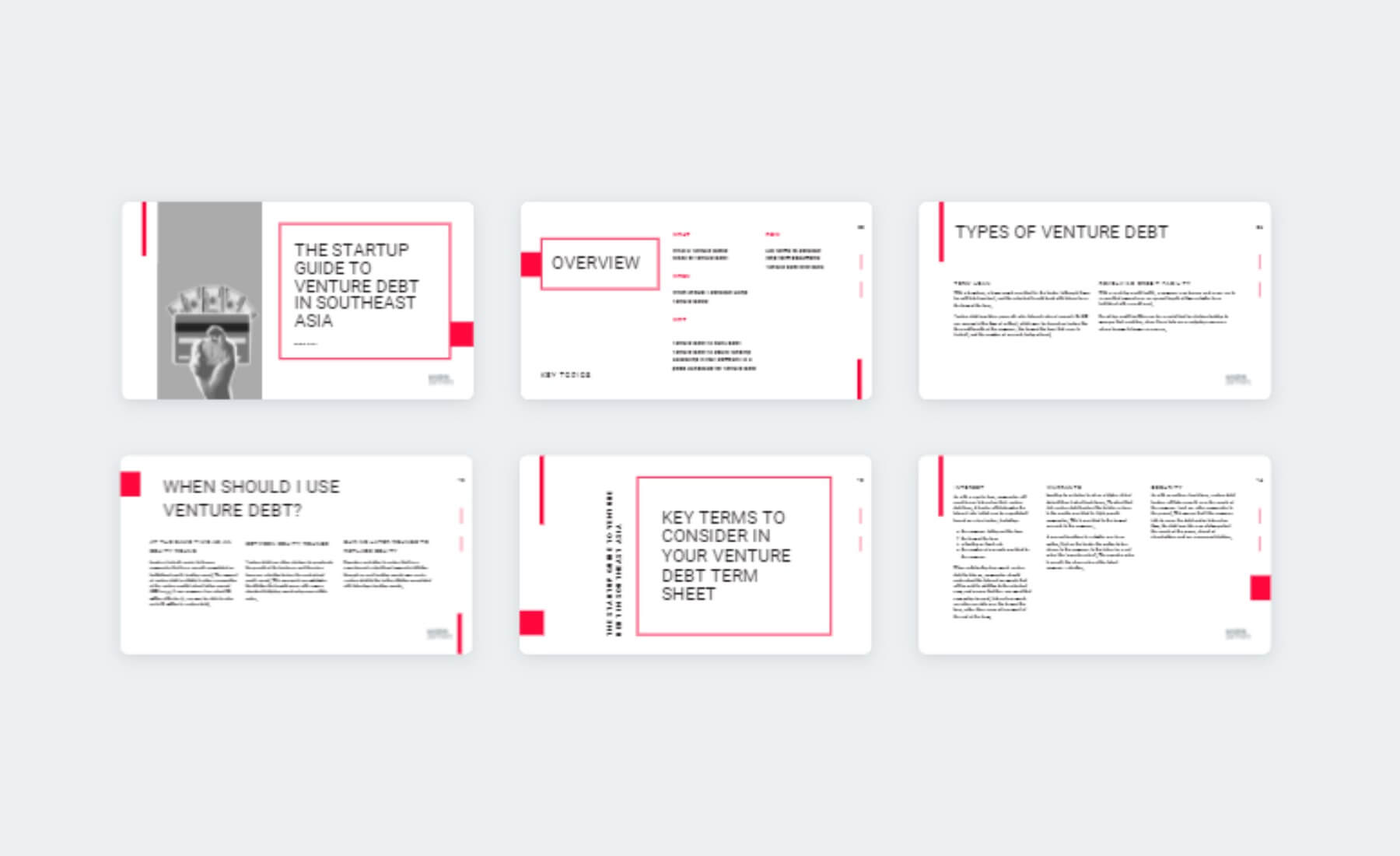
a primer on venture debt in southeast asia
Venture debt is fast becoming an alternative or complementary path for startups looking to get capital to accelerate their growth. Our guide covers what it is, the different forms of venture debt, why to use it compared to bank debt or equity financing, and key terms to consider.
subscribe to our newsletter and get the latest templates and tips for fast-growing startups in Southeast Asia
read our venture capital case studies and deal announcements

We’re pleased to have advised Philippine based e-commerce platform edamama on its US$20 million series A funding round led by Alpha JWC. Existing investors Gentree Fund, Robinson Retail Holdings, Innoven Capital, Kickstart Ventures and Foxmont Capital Partners also participated in the round.
edamama is a parenting-focused platform that offers customers a personalised shopping experience designed to simplify decision-making for parents. Following its launch in May 2020, the company has grown rapidly by providing families across the Philippines a safe and trustworthy way to digitally access an extensive range of parenting products through its proprietary technology. In addition to its innovative product offerings, edamama also provides an online gift registry and subscription services for essentials.
The company plans to use the funding to expand its operations, ramp up delivery solutions, and enhance its content and community. It also plans to open offline stores and scale its own private label portfolio.
Partner Lee Bagshaw says:
“edamama launched during the strict Covid lockdown imposed in the Philippines at a time where consumers were shifting from brick-and-mortar stores to e-commerce platforms. The business has continued to grow rapidly by establishing a reputation for providing affordable and quality products. We are delighted to have advised the company on their latest fundraise, one of the largest series A financings ever completed in the Philippines.”

Malaysian point of sale (POS) startup StoreHub is on a mission to help businesses execute better, through innovative technology and great design.
Wai Hong Fong, StoreHub CEO and co-founder, recently talked to us about his company and how he has found working with Kindrik Partners on their Series A capital raise.
the storehub story
Wai Hong refers to himself as an accidental entrepreneur. Most of his family are professionals and he says that it was a combination of kind of stumbling into opportunities plus being frustrated with a problem and wanting to solve it, which led him to where he is today.
After completing his BA in arts, media and philosophy at the University of Melbourne, he co-founded and became Managing Director at OZHut a lifestyle online retailer, where he did everything from writing code, web development and design, search engine optimization and even running the packing tables at the warehouse.
After 5 years at OzHut, he moved to China to study Mandarin and met a friend running a small retail store who asked him to look at his POS given Wai Hong’s e-Commerce background. He realised how terrible it was and not only wanted to help his friend fix this but other small to medium businesses that required offline and online sales support.
Wai Hong knew that the iPad POS was taking off in the US but there were no alternatives in Asia. With the belief that it was time for technology to revolutionise the traditional POS industry in Asia, and to help build better businesses, he co-founded StoreHub in 2013, along with current Chief Technology Officer, Congyu Li.
In the first 12 months of development, they bootstrapped the company then received a small investment from an angel investor, as well as a grant from Malaysia’s Cradle Fund. Wai Hong says that this initial funding allowed them to grow their product quickly and we’ve been cashflow positive and profitable since late 2015.
StoreHub is now a cloud-based iPad POS with inventory management, reporting and CRM, accessed via a mobile responsive backend, with over 850 retail stores paying a monthly subscription and customers in Malaysia, Philippines, Thailand and Indonesia.
In addition to the POS product offering, StoreHub supports its product with exceptional customer service based on the business to consumer experience which is not commonly offered by the industry.
In 2016, StoreHub announced a partnership with Malaysia-listed payments giant GHL Systems to deliver a fully integrated mobile point of sale (mPOS) credit card terminal and iPad POS solution. They also secured USD$850k in their Series A capital raising round from 500 Startups, as well as investors in China, Singapore and Malaysia.
Wai Hong says that StoreHub now plans to grow at least another 5 times its current size in the next year, add complementary products to their core offering and also enter new South East Asian markets, such as Thailand and Philippines.
challenges
Wai Hong notes that the biggest challenge for StoreHub is hiring and managing people, especially on a shoestring budget, talent acquisition and management is key.
The POS market is also highly competitive however StoreHub manages to differentiate because of their broad offering and leveraging their customer service focus which is generally seen as an afterthought in the industry. Being product and tech obsessed has also helped them stay ahead of the pack.
working with Kindrik Partners
Wai Hong primarily dealt with lawyers for the angel investment which involved local lawyers but it unfortunately turned out to be a painful and expensive experience.
He was then introduced to Kindrik Partners partner Lee Bagshaw through former Kindrik Partners lawyer, now investment analyst at tech VC Monks Hill, Lucy Luo. Lee supported StoreHub through the Series A capital raising, including drafting all of the documents which is unique for a deal like this, as investors usually provide the first round of documents.
Wai Hong says that it was our first serious cap raise and it was a refreshing experience given the angel investment round, knowing if I had an issue I would be getting sound advice. It made a huge difference that Lee thoroughly understood the South East Asian venture capital landscape, particularly as they had to negotiate with the investors.
Given Lee really understood StoreHub’s business, Wai Hong would work with him again on further corporate governance work like an Employee Share Options Scheme. He has also recommended both Kindrik Partners and Lee to a whole bunch of startups.
He says not only was Lee fast at delivering the work which helped StoreHub maintain their professionalism with investors, but he gets the space, market standards and provides valuable industry insights. Wai Hong thought Lee’s wealth of experience showed specifically when he advised on the all important term sheet, his advice and guidance was spot on.
Wai Hong also thinks that the Kindrik Partners Templates are also pretty cool, providing good information and learning points, and are a good starting point for legal work.
summing up
StoreHub’s growth is a testament to the company’s commitment to building a product and providing outstanding customer service. Kindrik Partners can’t wait to see what Wai Hong and the team have planned for their ambitious next steps.
Explore StoreHub.
[Note: The firm’s name was changed to Kindrik Partners in July 2020 and references to the firm’s previous name have been updated.]

Singapore-based Pixibo provides personalised size and fit recommendations in real time for online retailers and their customers. The fashion-tech startup worked with Kindrik Partners on their recent series A raise.
We spoke to founder and CEO Rohit Kumar on Pixibo, the capital raising journey, and working with Kindrik Partners.
pixibo’s story
Rohit is an ex-Googler with experience across Europe and India, before heading to Singapore to head up operations for e-commerce advertising company Sociomantic. Between 2013 and early 2016 he launched and managed all of Sociomantic’s APAC operations and was part of the team that sold the business to dunnhumby, a Tesco company.
It was at Sociomantic that Rohit identified an issue plaguing fashion e-commerce sites. People were browsing clothes online, but very few of those visits converted into sales. “The average conversion rate is 1.5%”, says Rohit.
Pixibo’s technology was formally launched in 2018, after a few years in development. The platform makes real-time size recommendations, personalised for every shopper and for every brand and SKU. For a retailer this boosts conversion rates, reduces return rate and improves customer satisfaction. Its size recommendation engine is entirely white labelled and can be natively integrated into online stores.
“In online shopping, there’s a lot of pain points, from finding something you like, to working out which size is correct for you,” says Rohit.
“Decision fatigue can come in, reducing sales and resulting in increased return rates. The Pixibo platform works to reduce the friction felt by the consumer and the retailer.”
working with kindrik partners
“I was educating myself about series A rounds when I came across Kindrik Partners’s content online,” Rohit says.
“It was my first time doing an institutional round so I was spending more time online trying to get my head around the legal terminology and the types of things that show up. Drag alongs, tag alongs, liquidation preference clauses. There’s a lot to understand.”
(confused? see our startup glossary )
“It looked like Kindrik Partners were the best lawyers for startups,” says Rohit.
“It was clear from the content that was available online that it was their area of expertise. When I eventually needed to bring in a lawyer to help with my round, I reached out.”
on the series A round
Pixibo already had several angel investors prior to their series A round in 2018, but the startup did not have any VCs on board, so the experience was new.
“We had VPs from Google who invested at an early stage, as well as strong private angel investors. But this was the first institutional round, and it felt very different.”
A big learning was how much longer the process took. “I thought you’d just go out to market, pitch, and then get them to sign. I eventually came to understand the level of process that institutional investors require, and how this stretches out the timeline.”
“There’s a great level of detail required. From investor interest to the term sheet to drafting the shareholder’s agreement, share subscription agreement and the whole nine yards, to signing, to getting money in the bank… it can take a long time!”
Fortunately, runway was less of a concern for Pixibo. “We weren’t in a rush. We had revenue, so there was no immediate need to get funding in”, says Rohit. “We already had a recurring revenue from our licence fees we were charging. That started conversations for us with investors, too.”
working with kindrik partners
Rohit found working with Kindrik Partners and partner Lee Bagshaw provided a lot of value during the capital raising process.
“Working with Lee was great. He was very responsive to my requests and concerns and was always happy to get on a call if need be to walk through things with me.”
Kindrik Partners’s experience in capital raising in Southeast Asia was also an asset to Pixibo.
“As a first time founder, sometimes you’re like wait, hang on, why is that in there? Lee was invaluable in these situations. He understood what terms were negotiable and what terms weren’t, and was instrumental during all of the back and forth with investors.”
tips for founders embarking on their A round
Rohit has a few tips for those entrepreneurs who are considering going out to do their series A round.
- start out 6 -8 months before you need the capital: especially if it’s your first institutional round (it gets easier with a follow-on round, because you’ll have existing investors to help you get your foot in the door).
- consider a rolling close: since you’re looking for investors who are the right fit in a long-term partnership, having a rolling close allowed Pixibo to get the money in the bank from the investors who were committed, while continuing to find the perfect fit to close out our round.
- beware the temptation to think that any money will do: in the beginning, the temptation is to look for anyone with a cheque book, but then you get smarter. Find the VC’s thesis and their sweet spot, and get smarter at looking at their portfolio to see if you fit in. Who will be interested in your story?
- don’t raise too soon: Traction is important. Wait until you’re in a strong position to raise, if you can. In our case, as we’re B2B, we had clear proof points that our product works, solves a real problem for online retailers and that they are willing to pay us for it. Investors will want to see that you have put in the hard work and that capital will accelerate growth.
- have a plan for the money. You have to articulate why you need capital now, and how it will help your business.
what’s to come for pixibo
The future is bright for Pixibo, and Rohit is looking ahead to expand into new markets. “The most exciting thing about us is that we’re location agnostic. The problems retailers have in Singapore are the same ones that they have in Sydney. The opportunity is massive.”
[Note: The firm’s name was changed to Kindrik Partners in July 2020 and references to the firm’s previous name have been updated.]
