startup lawyers
startup lawyers
It seems like everyone you meet these days has founded a startup, works at a startup, or wants to sell you a package for startups. Or maybe we spend too much time hanging out at tech incubators?
A typical engagement with a Southeast Asian startup involves helping the business set up in, or flip to, Singapore. We then put in place governance documents such as a constitution, shareholders’ agreement and founder vesting documents.
Early on, we help Singapore startups get investment ready, taking care of the legal basics that investors expect to see covered. As your business grows, we also advise on company or group structuring, contractor arrangements and employee share incentive schemes.
We understand that cash is tight, yet there are endless issues to think about. To help out, we’ve developed free legal templates which you can use to cover the basics when you are just starting out. These tools are also a great learning resource.
Our team has learnt a massive amount about tech business over the years. Our startup clients get the benefit of that experience as part of the package, whether we are on the clock or catching up over a coffee.
"Kindrik Partners were instrumental to a fast and favourable outcome on the round.
As first time founders, we relied on their partnership for not only support with the necessary documentation, but advice on standard processes and critical regional context on terms."will hanschell, founder, pencil
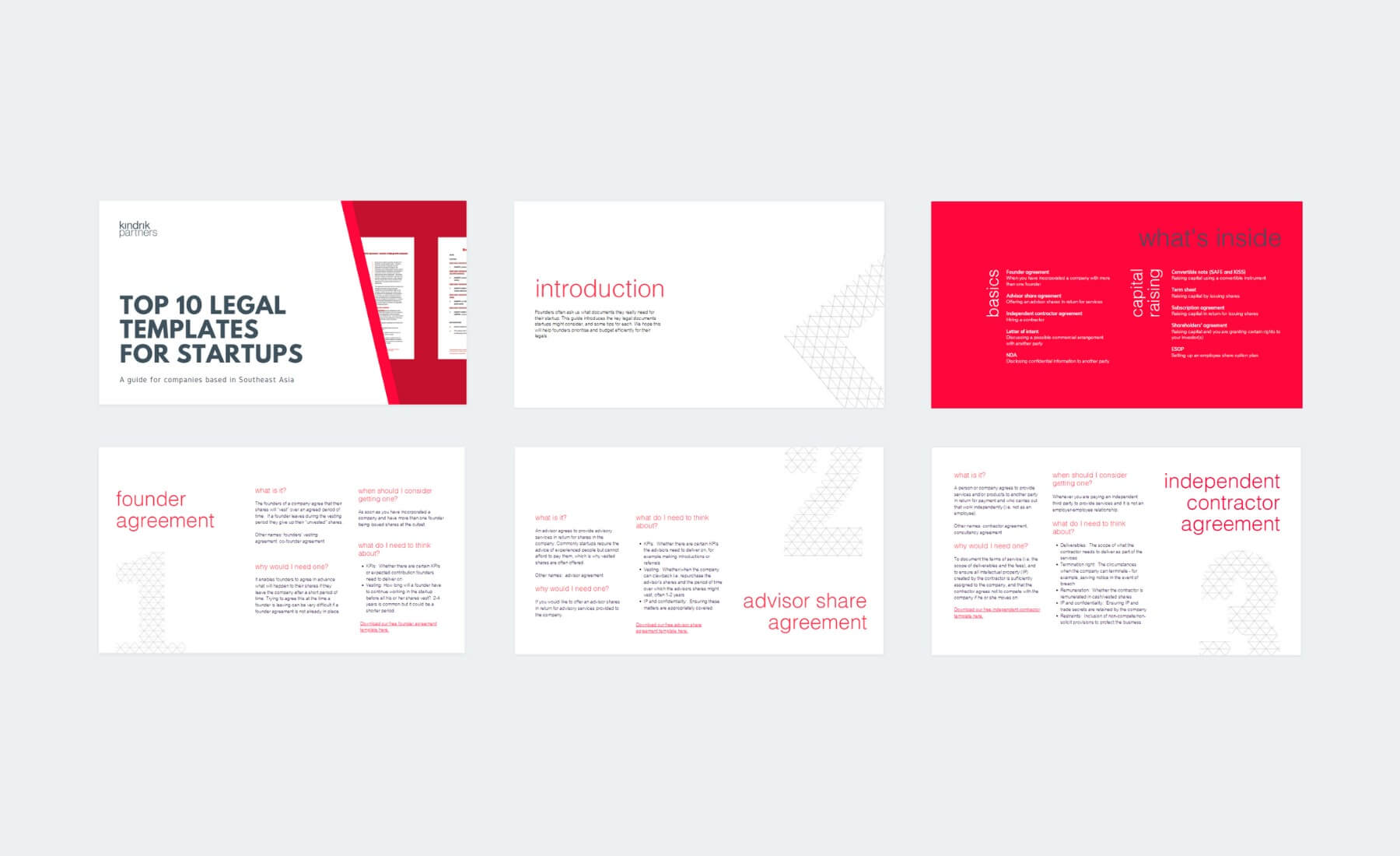
top 10 legal templates for startups
From venture capital to drafting governance contracts, we help startups every day with their legal needs. We’ve rounded up our most popular templates and tips for putting this paperwork in place.
browse our other startup resources
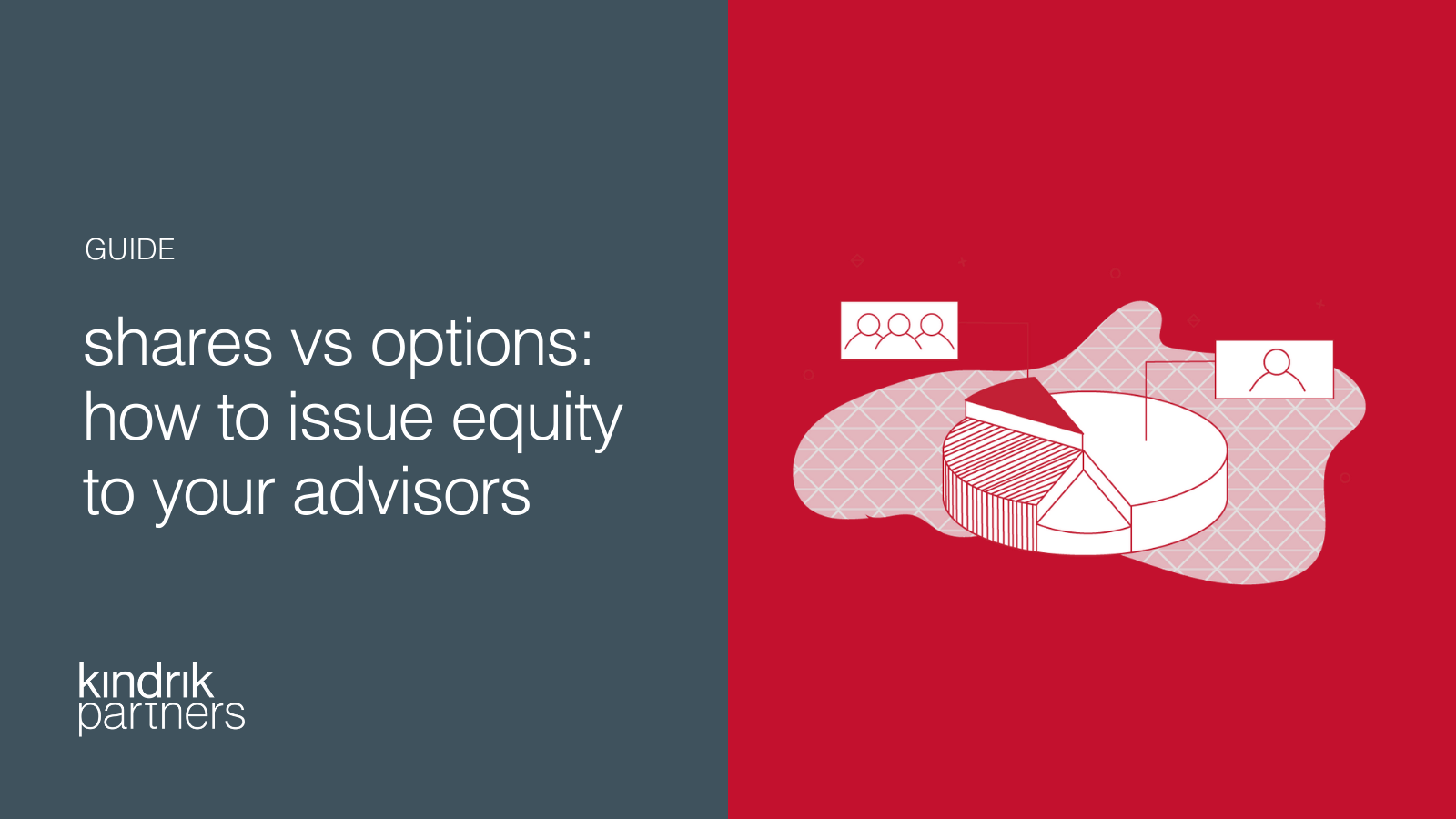
Advisors help startups by offering expertise or perspectives that the core founder team may not have. Since most startups don’t have the cash to compensate these advisors, a common way to pay for their guidance is to offer equity.
We are often asked how companies should best go about this. In this guide we cover the types of advisor equity (shares versus options), how vesting can be incorporated, what else to cover, and other common questions.
types of advisor equity
When offering equity to advisors, there are two common roads to take: either giving shares, or granting options. The fundamental difference between shares and options is that if someone owns shares, they are immediately a shareholder in the company. If someone owns options, they have the right to purchase shares in the future.
share issue
Shares are a straightforward way to compensate an advisor. In most cases, advisors prefer shares rather than receiving options under the company’s option scheme. Like any share issue, the company will need to pass board and shareholder resolutions, as well as receiving necessary waivers and consents under the constitution and shareholders’ agreement in place. For that reason, a company intending to issue shares to advisors in the future usually carves this out under the constitution and shareholders’ agreement in the same way as they would an ESOP.
granting options
Options are an alternative way to compensate an advisor, and can be granted easily if a pool of options (such as an ESOP) has already been established. However, often advisors can come on board before the ESOP is formally set up.
If options are issued to an advisor, in the event that the advisor wants to exercise their options and convert them into shares, they will need to pay the ‘exercise price’, which may be around the price that the investors paid in the last funding round. This means that they will need to come up with cash to exercise their options.
how much to give?
There are different models to decide how much equity to offer. The Founders Institute gives a useful framework based on the stage of the company (idea, startup, or growth) and based on the various levels of engagement. This is really just a guide however.
| Idea Stage | Startup Stage | Growth Stage | |
| Standard: Monthly Meetings | 0.25% | 0.20% | 0.15% |
| Strategic: Add Recruiting | 0.50% | 0.40% | 0.30% |
| Expert: Add Contacts & Projects | 1.00% | 0.80% | 0.60% |
https://fi.co/insight/the-founder-institute-s-standard-advisor-agreement-for-startups-fast
vesting schedule
Advisor agreements typically have a vesting schedule of around 12-24 months, i.e. they are shorter than vesting schedules for founders and employees under an ESOP. This is because advisors generally bring greater value over a short term. As your startups grow, it cycles through different advisors that fit their applicable stage of growth.
Some advisor agreements also contain some measure of ‘claw back’ if the advisor does not perform make the expected contributions over the agreed period. An alternative to a provision like this would be using a cliff of 3-6 months to provide for a ‘test run’ to see if the relationship is beneficial.
other provisions
The advisor should agree that all intellectual property and other business, technical and financial information that the advisor obtains from the company or learns in connection with his or her services is appropriately assigned to the company.
As a minimum, the advisor should be subject to confidentiality provisions. You may want to add a no-conflict provision, and also a provision that the advisor complies with certain company policies.
Finally, there is usually a termination right for both parties and sometimes automatic termination if the company has not requested that the advisor render any services for a lengthy period.
tax implications
Options and shares are treated differently with regards to how they are treated in a tax sense. Generally speaking if you are issued shares for services, you would expect to have an income tax liability whereas options do not trigger a liability until exercised. We recommend obtaining tax and accounting advice before putting in place any advisor agreement.
advisor agreement template
We have produced a simple template agreement that a startup can use when bringing an investor on board. The template is drafted on the basis that the advisor receives shares, and that no cash compensation will be paid. It also provides that some of the shares may be clawed back by the company if the advisor fails to make the expected contributions over the agreed period, which is usually one or two years.
You can download our advisor share agreement template here. If you have any questions regarding the template or want to work with us to draft your advisor agreement, get in touch.

In the last few years, convertible notes have been frequently used on Singapore financings. Perhaps less common has been the use of SAFEs – the instrument created by Y-Combinator (YC) several years ago. However SAFEs are on the increase on fundraising deals across Southeast Asia.
Two years ago, YC reinvented the SAFE and launched what is now known as the ‘post-money’ SAFE. And just last month they released beta versions of the “Valuation Cap, no Discount” post-money safe and side letter specifically for companies registered in Singapore. You can access these here.
quick reminder – what’s a SAFE?
A simple agreement for future equity – in short, it’s an instrument convertible into shares similar to a KISS or convertible note. What’s different with a SAFE is that it doesn’t typically have any interest accruing, nor any maturity date and repayment obligation. They are therefore seen as a founder friendly investment tool to raise capital.
Like KISSes and other convertible notes, SAFEs typically convert into shares on the basis of a conversion price which is usually an agreed discount to the price of the next equity round, but which is subject to an overall valuation cap – i.e. whichever gives the lower price for investors.
so, what changed with the ‘post-money’ SAFE?
post-money SAFEs don’t dilute each other (bad news for founders)
The main change is that the new SAFE uses a post-money valuation cap instead of pre-money. The drafting change is fairly subtle to see: the definition of Fully Diluted Capital in the SAFE is amended to reflect the new principle. However, the impact can be significant. It means that the company’s valuation for calculating the conversion is “post” (i.e. after) the conversion of any other SAFEs or convertible instruments issued by the company, but prior to the valuation of the company immediately after the equity financing round. This results in further dilution for founders on conversion and potentially to any other investors that do not hold post-money SAFEs.
Just to be clear and to dispel a myth, by ‘post-money’, this is post all other SAFEs and convertible notes, but not post the next equity financing as well, as some founders have asked. That really would cause dilution!
Under post-money SAFEs, the post-equity financing option pool is no longer factored into the pre-money calculations, which actually benefits founders from a dilution perspective. Under the original SAFE, option pool expansions resulted in SAFE investors receiving additional shares. However, overall this doesn’t balance out the additional dilutive effect outlined above.
you’ll only feel the impact with multiple rounds of SAFEs
It is worth pointing out that for a company that only ever raises one SAFE investment round, a post-money SAFE has no real impact. Rather, it comes into play when more than one series of SAFEs or other convertible notes are issued. In Singapore, we perhaps see this less commonly than say in the US where substantial amounts are often invested using SAFEs and other convertible instruments, and not only in the first round of investment.
easier to calculate cap table (good news for founders)
YC’s view at the time of launching the new SAFE was that it makes the maths simpler for everyone and creates more certainty over ownership and dilution. Which is probably true. But if you issue more than one round of SAFEs or other convertible notes, and you use post-money SAFEs, founders will likely experience more dilution on conversion than they would have done under the original YC SAFE, simple as that.
In light of this, if presented with a post-money SAFE, founders may want to negotiate up the valuation cap to mitigate against the dilutive impacts potentially coming into effect.
what else did YC change?
The original YC SAFE granted holders a pro-rata right on the next financing round. The new SAFE doesn’t automatically include this. Instead, YC put out a separate side letter on their website under which these additional pro-rata rights might be granted.
Also, the old SAFE could only ever be amended by the holder. The new SAFE on the other hand permits amendments by written consent from a majority of SAFE holders. This is something we think is valuable on all convertible instruments, i.e. the holders effectively make decisions on a consensus basis, avoiding one single small investor taking a different view holding things up.
other key points to remember about a SAFE
Not specific to the new post money version, but whenever drafting or reviewing a SAFE, keep these tips in mind:
- Look out for most favoured nation (MFN) provisions. These enable early investors to have the benefit of any rights granted to future SAFE holders which might be more beneficial. If nothing else, it can be a burden reissuing new SAFEs on these better terms to lots of prior investors.
- SAFEs typically convert automatically on completion of the next equity financing. There should ideally be no minimum amount to be raised to trigger this automatic conversion under a SAFE. Some investors like to include a threshold to ensure it is a legitimate fundraising round. Always be careful you do not go too high with this so as to prevent automatic conversion of the SAFE.
- A SAFE (like all convertible instruments) should include language to the effect that, on conversion, holders will only have the benefit of their lower conversion price for the purposes of liquidation preference and anti-dilution rights. This can be achieved through issuing a separate class of “shadow” preferred shares, or just by drafting carefully the relevant provisions in the constitution and shareholders agreement put in place on the equity round.
round up
If you are presented with any kind of SAFE right now, it will most likely be the post-money version, so come and have a chat to us.
subscribe to our newsletter and get the latest templates and tips for fast-growing startups in Southeast Asia
read our startup case studies

Malaysian point of sale (POS) startup StoreHub is on a mission to help businesses execute better, through innovative technology and great design.
Wai Hong Fong, StoreHub CEO and co-founder, recently talked to us about his company and how he has found working with Kindrik Partners on their Series A capital raise.
the storehub story
Wai Hong refers to himself as an accidental entrepreneur. Most of his family are professionals and he says that it was a combination of kind of stumbling into opportunities plus being frustrated with a problem and wanting to solve it, which led him to where he is today.
After completing his BA in arts, media and philosophy at the University of Melbourne, he co-founded and became Managing Director at OZHut a lifestyle online retailer, where he did everything from writing code, web development and design, search engine optimization and even running the packing tables at the warehouse.
After 5 years at OzHut, he moved to China to study Mandarin and met a friend running a small retail store who asked him to look at his POS given Wai Hong’s e-Commerce background. He realised how terrible it was and not only wanted to help his friend fix this but other small to medium businesses that required offline and online sales support.
Wai Hong knew that the iPad POS was taking off in the US but there were no alternatives in Asia. With the belief that it was time for technology to revolutionise the traditional POS industry in Asia, and to help build better businesses, he co-founded StoreHub in 2013, along with current Chief Technology Officer, Congyu Li.
In the first 12 months of development, they bootstrapped the company then received a small investment from an angel investor, as well as a grant from Malaysia’s Cradle Fund. Wai Hong says that this initial funding allowed them to grow their product quickly and we’ve been cashflow positive and profitable since late 2015.
StoreHub is now a cloud-based iPad POS with inventory management, reporting and CRM, accessed via a mobile responsive backend, with over 850 retail stores paying a monthly subscription and customers in Malaysia, Philippines, Thailand and Indonesia.
In addition to the POS product offering, StoreHub supports its product with exceptional customer service based on the business to consumer experience which is not commonly offered by the industry.
In 2016, StoreHub announced a partnership with Malaysia-listed payments giant GHL Systems to deliver a fully integrated mobile point of sale (mPOS) credit card terminal and iPad POS solution. They also secured USD$850k in their Series A capital raising round from 500 Startups, as well as investors in China, Singapore and Malaysia.
Wai Hong says that StoreHub now plans to grow at least another 5 times its current size in the next year, add complementary products to their core offering and also enter new South East Asian markets, such as Thailand and Philippines.
challenges
Wai Hong notes that the biggest challenge for StoreHub is hiring and managing people, especially on a shoestring budget, talent acquisition and management is key.
The POS market is also highly competitive however StoreHub manages to differentiate because of their broad offering and leveraging their customer service focus which is generally seen as an afterthought in the industry. Being product and tech obsessed has also helped them stay ahead of the pack.
working with Kindrik Partners
Wai Hong primarily dealt with lawyers for the angel investment which involved local lawyers but it unfortunately turned out to be a painful and expensive experience.
He was then introduced to Kindrik Partners partner Lee Bagshaw through former Kindrik Partners lawyer, now investment analyst at tech VC Monks Hill, Lucy Luo. Lee supported StoreHub through the Series A capital raising, including drafting all of the documents which is unique for a deal like this, as investors usually provide the first round of documents.
Wai Hong says that it was our first serious cap raise and it was a refreshing experience given the angel investment round, knowing if I had an issue I would be getting sound advice. It made a huge difference that Lee thoroughly understood the South East Asian venture capital landscape, particularly as they had to negotiate with the investors.
Given Lee really understood StoreHub’s business, Wai Hong would work with him again on further corporate governance work like an Employee Share Options Scheme. He has also recommended both Kindrik Partners and Lee to a whole bunch of startups.
He says not only was Lee fast at delivering the work which helped StoreHub maintain their professionalism with investors, but he gets the space, market standards and provides valuable industry insights. Wai Hong thought Lee’s wealth of experience showed specifically when he advised on the all important term sheet, his advice and guidance was spot on.
Wai Hong also thinks that the Kindrik Partners Templates are also pretty cool, providing good information and learning points, and are a good starting point for legal work.
summing up
StoreHub’s growth is a testament to the company’s commitment to building a product and providing outstanding customer service. Kindrik Partners can’t wait to see what Wai Hong and the team have planned for their ambitious next steps.
Explore StoreHub.
[Note: The firm’s name was changed to Kindrik Partners in July 2020 and references to the firm’s previous name have been updated.]
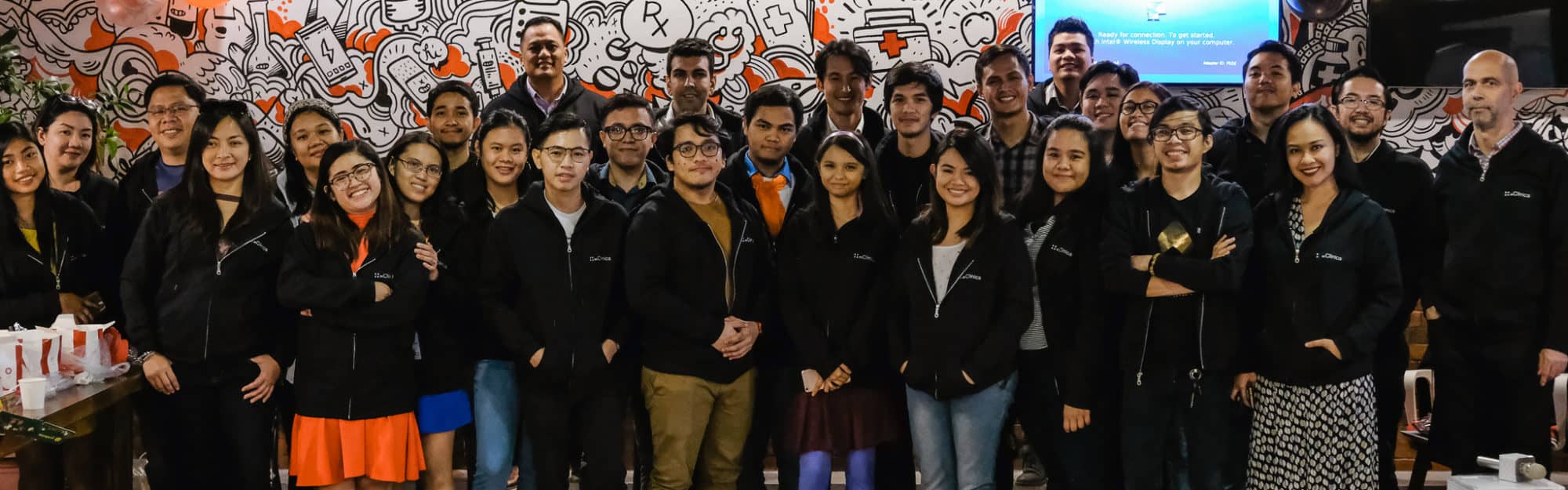
mClinica is a Singapore-headquartered health-tech company which provides data, analytics, and patient engagement tools for healthcare organisations in Southeast Asia. In 2017, mClinica closed a USD$6.3million series A financing round, with Kindrik Partners advising the company.
Founder and CEO Farouk Meralli talked to us about mClinica’s journey to date and working with Kindrik Partners.
the mClinica story
Whilst working for multinational pharmaceutical companies, Farouk identified issues in the healthcare sector in emerging markets. Pharmaceutical companies and public sector entities (NGOs and governments) lack access to consolidated data that similar companies in developed markets have. This is particularly so in Southeast Asia where pharmacies are mainly independent owner-operated businesses rather than the large branded chains that you see in established markets.
This led Farouk to start mClinica to connect pharmacies on a common mobile platform. The company launched in the Philippines in 2013, and has since expanded to Indonesia, Vietnam, Thailand and Malaysia. By the end of 2017, mClinica had connected over 60,000 pharmacy professionals and 12,000 pharmacies on a single digital platform. This platform now addresses several challenges in healthcare including education and engagement of pharmacy professionals, pharmacy-driven patient programs, and last-mile data.
Farouk recently received the Public Health Innovator Award from Harvard University for his work with mClinica, and was the youngest ever recipient of the award.
challenges
Due to the fragmented nature of the healthcare industry in Southeast Asia, developing mClinica’s products was no easy feat. Farouk had to recruit healthcare professionals who also had expertise in mobile technology, engage with lots of government agencies and regulators, and develop products that were flexible enough to work in different health contexts. However, Farouk’s patience and vision has paid off, with its pharmacy network now reaching approximately 80 million patients per month.
The business has also been through some financing rounds and other corporate transactions along the way, which Farouk admits can be a big distraction from the day job of growing the business – like all entrepreneurs, he just wants to focus on solving real problems for end users.
raising a series A round
mClinica’s series A round was led by Silicon Valley fund, Patamar Capital (formerly Unitus Impact), and joined by UK based Global Innovation Fund, MDI Ventures, and Endeavor Catalyst. Existing investors also took part in the investment round.
The cap raise was to help mClinica grow faster and enter more markets across Southeast Asia. By 2017, mClinica had a good profile in the regional tech and healthcare scene, and was known to investors. The company therefore had the luxury of picking investors that had knowledge of the healthcare space and would offer the best long-term strategic value.
In the end, mClinica was able to secure investment from well-known international investors, all of whom believed in the vision of transforming healthcare in Asia. A term sheet followed, and once a lead investor was committed, was agreed fairly quickly.
Farouk described an important aspect of the transaction was discussing the term sheet openly with all interested parties from the outset. This included existing seed investors who required careful management to avoid roadblocks later in the deal process.
working with Kindrik Partners
mClinica has worked with Lee Bagshaw since the incorporation of the business, including advising on seed funding deals with Kickstart Ventures, Spiral Ventures (formerly IMJ Investment Partners) and 500 Startups. Kindrik Partners has helped the company with other corporate and commercial matters, aside from the series A deal.
Farouk says: I believe mClinica was one of Lee’s first clients in Southeast Asia. Therefore to some extent we’ve been on the journey together in what is an exciting but challenging digital market. We feel like we’re in safe hands with Kindrik Partners. The team is very easy to work with and their VC transaction experience is second to none.
what’s next?
Since completing its series A financing, mClinica has continued to expand its pharmaceutical network, work on product development and grow its team. Right now, the focus is still on Southeast Asia, but mClinica’s products are also suited to many other developing countries worldwide.
As a transformative health-tech company operating in emerging economies, we’re proud to have been a part of Farouk’s journey to date. The digital economy in Southeast Asia will play a great role in improving healthcare delivery over the next decade and mClinica is leading the way.
[Note: The firm’s name was changed to Kindrik Partners in July 2020 and references to the firm’s previous name have been updated.]

Singapore company CardUp is an online platform that lets individuals and SMEs pay for expenses like taxes, rent, or even payroll, using their credit card – even if the recipient doesn’t accept cards.
Cardup raised a seed round lead by top tier venture firm Sequoia Capital in late 2017. We spoke to founder Nicki Ramsay about Cardup’s journey so far.
story
Nicki got the idea for CardUp while working at a major credit card provider in Singapore. She saw that a lot of big ticket items (like tax and rent) could not be paid for with a credit card, because the recipients were not willing to go through the hassle and fees associated with the setup process. This meant that card holders were not getting benefits from these big payments such as being able to access their credit facility or earn loyalty reward points. In addition, banks were losing out on the fees that would be linked to an increase in credit card spending.
CardUp solves this by flipping the existing card processing model, acting as the middleman between cardholders that want to use their card in more ways and recipients who don’t accept card payments. CardUp users benefit from using the credit line on their card to extend the payables period for these expenses, as well as earning credit card loyalty points and rewards. In addition, the recipient does not need to have a CardUp account to receive credit card payments.
Finding the initial capital and relevant expertise needed to get a company off the ground is a challenge for a lot of the founders that we work with. This is particularly common for solo founders like Nicki, as they are not able to draw on the financial resources and connections of their co-founders. In Nicki’s case, she decided to join The Finlab (United Overseas Bank’s Singapore fintech accelerator), which was a great way to access mentorship and exposure to a wide investor community.
While at The Finlab, Nicki spent a lot of time talking to financial institutions, to get them on board with cardholders using the platform. CardUp has since secured partnerships with many of Singapore’s major banks to promote CardUp’s services. The company also promoted the platform to individuals and SMEs through its online marketing content. The focus of this material was to educate users on the platform’s benefits and how the platform works.
the financing deal
As CardUp gained more users, the company needed to raise some money to further develop its platform.
Nicki pitched to a wide range of VCs in Southeast Asia. Sequoia was a natural fit as they are deep in the payments space, and CardUp is disrupting traditional payment processing models.
Other investors included SeedPlus, who were originally introduced to Cardup by The Finlab.
The company completed its ~US$1.7m seed round in late 2017. The investment has allowed the company to triple the size of its team in just a few months.
working with us
Nicki told us that Kindrik Partners’ depth of knowledge on VC deals in Southeast Asia was a massive help throughout the capital raising process:
Kindrik Partners added a lot of value for us during the negotiation with Sequoia as they have vast experience with startup and VC deals in the region and are very familiar with the different permutations of VC term sheets. Also, because they have acted for a lot of startups taking investment from Sequoia, they saved us time and cost by telling us which points Sequoia would likely be open to negotiating.
Overall, Nicki said that the Kindrik Partners team were extremely knowledgeable, and professional to deal with.
Having worked with Nicki, we are now certain that it won’t be long before everyone will be using their credit card for important payments, like their legal fees!
Explore CardUp.
[Note: The firm’s name was changed to Kindrik Partners in July 2020 and references to the firm’s previous name have been updated.]
