browse our free startup resources
Starting up? Start here. We have all the information and resources you need for your startup in Southeast Asia.

legal resources for startups in singapore and southeast asia
what you'll find here
We’ve rounded up our best resources for startups that are free for you to access – from free templates to easy-to-follow guides.
made for cash-strapped startups
Our aim is to empower startups to self-serve their legal basics. Browse our documents, download what you need, and save your legal spend for the things that really matter.
available for template questions
If you need to talk, just get in touch with one of our startup lawyers in Singapore.

top 10 legal templates for startups
From venture capital to drafting governance contracts, we help startups every day with their legal needs. We’ve rounded up our most popular templates and tips for putting this paperwork in place.
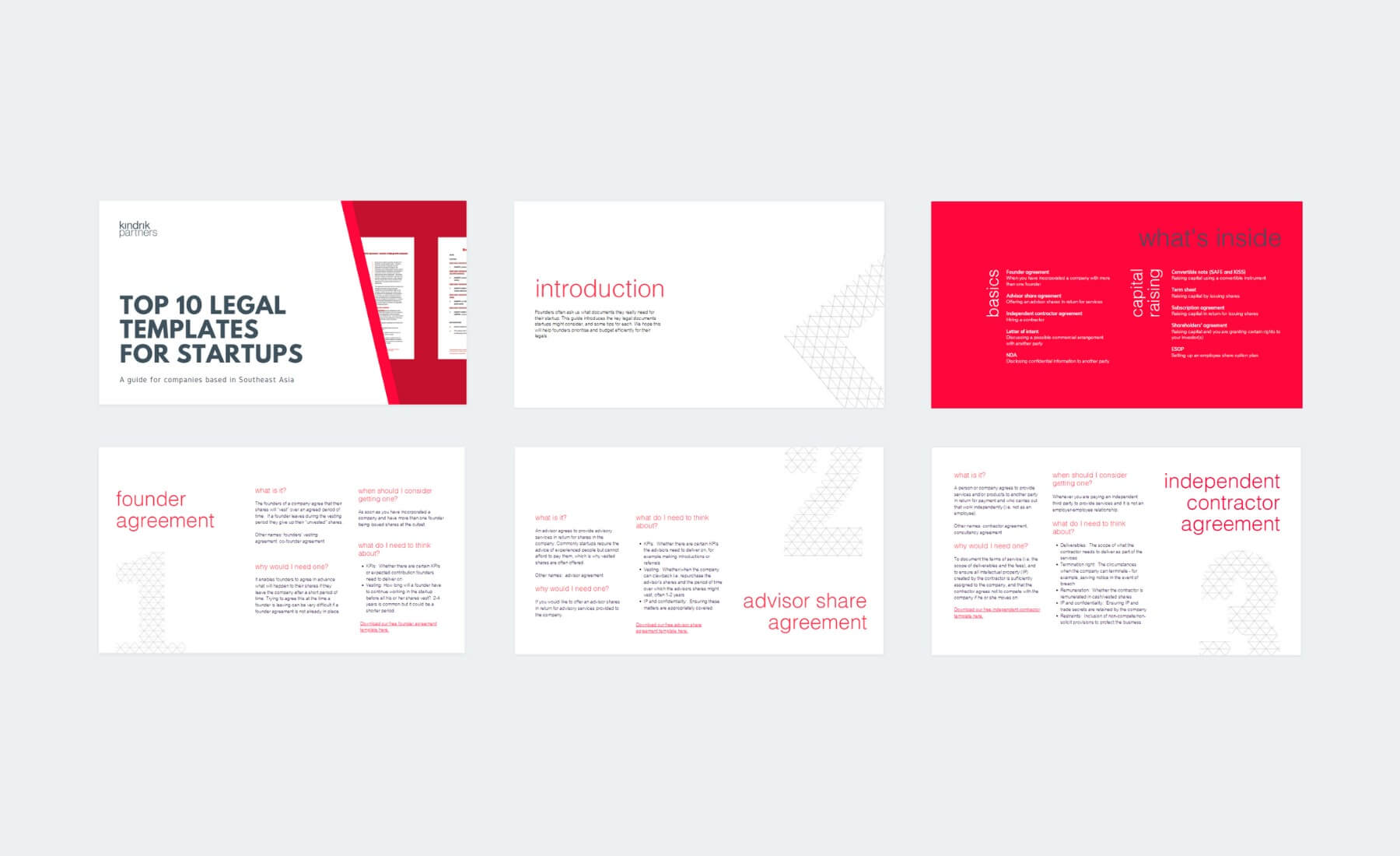
free startup templates
Browse our free startup templates and get your legal basics covered.

This agreement is for use when a company primarily wishes to bring in employees from a target company, rather than acquiring its business. Acqui-hires are common amongst well-funded startups looking to expand their teams by hiring talent from other startups. Often the employees are acqui-hired from businesses that are failing and are subsequently shut down.
This agreement covers the transfer of the employees and release of any existing restraints, together with a general assignment of intellectual property rights. It sets out the terms of payment of the acquisition amount – this is sometimes paid in tranches and adjusted if the transferring employees subsequently move on soon after completion of the acqui-hire.
using our templates
Use of a template by business users is free of charge and is subject to you agreeing to our template terms of use.

This is a simple agreement for the provision of advisory services to an early stage company (including where a company is establishing a formal advisory board).
This template is drafted on the basis that the advisor is to receive shares in the company as compensation for the services provided. It assumes no cash compensation will be paid. Some of the shares may be clawed back by the company if the advisor fails to make the expected contributions over the agreed period, which is usually one or two years.
using our templates
Use of a template by business users is free of charge and is subject to you agreeing to our template terms of use.
This template cap table is intended for use when considering a potential equity investment in a company (whether from existing shareholders, external investors, or both). The template works when the number of new shares to be issued is calculated:
- based on a specific investment amount at a specific pre-money valuation of the company e.g. an aggregate investment of $500,000 at a pre-money valuation of $2m
- on a fully diluted basis i.e. all unexercised options (if any) are treated as existing shares in the company for the purpose of calculating the number of new shares to be issued
- no anti-dilution rights are triggered by the issue of the new shares
- all shares issued in consideration for the conversion of debt to equity are issued at a discount to the price per share paid by the cash investors. If all of the debt is converting at the same price per share paid by the cash investors please use our template investment capitalisation table for debt converting without a discount
- the investment is made on a fully diluted basis, i.e. if a new employee share option plan (ESOP) is established as part of the investment round, the dilutionary effect of the ESOP is borne entirely by the founders and any other existing shareholders, and not by the investors. This is the most common approach.
using our templates
Use of a template by business users is free of charge and is subject to you agreeing to our template terms of use.
This template cap table is intended for use when considering a potential equity investment in a company (whether from existing shareholders, external investors, or both). The template works when the number of new shares to be issued is calculated:
- based on a specific investment amount at a specific pre-money valuation of the company e.g. an aggregate investment of $500,000 at a pre-money valuation of $2m
- on a fully diluted basis i.e. all unexercised options (if any) are treated as existing shares in the company for the purpose of calculating the number of new shares to be issued
- no anti-dilution rights are triggered by the issue of the new shares
- all of the new shares are issued at the same price per share, including any new shares issued in consideration for the conversion of debt to equity. If all of the debt is converting at a discount to the price per share paid by the cash investors (e.g. under the terms of an existing convertible loan agreement) please use our template investment capitalisation table for debt converting at a discount.
- the investment is made on a fully diluted basis, i.e. if a new employee share option plan (ESOP) is established as part of the investment round, the dilutionary effect of the ESOP is borne entirely by the founders and any other existing shareholders, and not by the investors. This is the most common approach.
using our templates
Use of a template by business users is free of charge and is subject to you agreeing to our template terms of use.
This is a template checklist which sets out the steps typically required to take a series A investment transaction from signing to completion. The items included are examples only; when creating your own checklist you should always refer to the key transaction documents (typically a subscription agreement and shareholders’ agreement, and a new constitution reflecting the terms of the shareholders’ agreement) to determine what items need completing.
As this checklist covers only the most typical completion steps, it does not provide for the following items which are sometimes seen on investment transactions:
- a rolling close, under which the company has a set amount of time after completion to find investment from other investors on the same terms
- investment in tranches, i.e. more than one closing date
- conversion of any debt or convertible notes on completion of the investment.
using our templates
Use of a template by business users is free of charge and is subject to you agreeing to our template terms of use.
This document is intended for use by the founders of a new startup who wish to provide for some level of claw-back of a co-founder’s initial shareholding if he or she:
- ceases to work for the company (whether as an employee or contractor); or
- fails to make the contribution required of them to the business.
This type of arrangement is referred to in the startup and venture capital world as founder vesting.
The approach taken in this document is to provide for progressive vesting of a co-founder’s shares over a set period (e.g. 36 months). If the co-founder leaves the company or fails to make the required contribution to the business during that period, the company has the option to repurchase unvested shares for the price originally paid by the co-founder for those shares (which will usually be nil, if the shares were issued on incorporation of the company).
using our templates
Use of a template by business users is free of charge and is subject to you agreeing to our template terms of use.

This document is a short form co-founder agreement intended for use by the founders of a new startup who wish to provide for some level of claw-back of a co-founder’s initial shareholding if he or she ceases to work for the company (whether as an employee or contractor). In this document, the company’s right to purchase shares is limited to a situation where the co-founder ceases to work for the company, i.e. there is no expected contribution from the co-founder. If you would like the company to be able to repurchase shares for a failure by the co-founder to contribute to the company, use our southeast asia co-founder agreement – long form.
This type of arrangement is referred to in the startup and venture capital world as founder vesting.
The approach taken in this document is to provide for progressive vesting of a co-founder’s shares over a set period (e.g. 36 months). If the co-founder leaves the company during that period, the company has the option to repurchase unvested shares for the price originally paid by the co-founder for those shares (which will usually be nil, if the shares were issued on incorporation of the company).
using our templates
Use of a template by business users is free of charge and is subject to you agreeing to our template terms of use.
This is a simple company friendly consultancy agreement for engaging independent contractors or consultants (e.g. individuals or sole operator companies) to work within a business.
This template includes a restraint on the independent contractor to ensure that the independent contractor does not jeopardise the company’s business (by competing or similar) during the term and for a set period after. To be enforceable, a restraint must be reasonable. This, in turn, will depend on the facts relating to the agreement. However, the longer the restraint and the broader the restrained area, the more likely that arguments could be raised about the enforceability of the restraint.
using our templates
Use of a template by business users is free of charge and is subject to you agreeing to our template terms of use.

Technology businesses in Southeast Asia often have group structures. For example, a business may have trading subsidiaries in Indonesia, Malaysia and/or the Philippines, and a holding company in Singapore. Loan arrangements within such group structures are relatively common.
This is a simple intercompany loan agreement that records an unsecured loan between group companies.
using our templates
Use of a template by business users is free of charge and is subject to you agreeing to our template terms of use.
This document is intended for use by the founders of a startup company to formally transfer intellectual property relevant to the business, products or services of the company, to that company.
Before completing this deed, we suggest that companies and their founders first work to identify and record the intellectual property that the company intends to use (or is already using) in its business, including details of who:
- created the intellectual property, and on what basis (e.g. as a founder, employee or external consultant of the company)
- owns that intellectual property and on what basis (i.e. if the company owns intellectual property because it was created by its employees in the course of their employment, this should be recorded)
This will help:
- to identify intellectual property that needs to be transferred by a founder or consultant, etc. to the company (and to properly describe that intellectual property in a deed of assignment)
- to prove ownership of the company’s intellectual property in the future, e.g. in a capital raising or M&A transaction.
using our templates
Use of a template by business users is free of charge and is subject to you agreeing to our template terms of use.
This is a simple document to outline the main in principle terms of a proposed commercial relationship. The document is not legally binding (other than the confidentiality, termination, and governing law provisions in part D).
Other than the statement that the document is not intended to be binding and part D, there is no suggested content included – the document is simply a framework for the parties to record the in principle commercial terms that have been agreed, prior to preparing a formal agreement.
Although the letter of intent is non-binding, it can create moral or ethical obligations that are difficult to back away from. It is therefore important not to over-promise, and to set out relevant assumptions.
This document does not include an exclusivity provision – either party is free to enter into negotiations, or contract, with third parties for a similar or competing relationship.
using our templates
Use of a template by business users is free of charge and is subject to you agreeing to our template terms of use.
This is a simple mutual (or two way) confidentiality agreement setting out the terms on which each party will keep confidential the other party’s information.
It has been drafted to be fair to both parties and to enable easy signing (without the need for lengthy negotiation). If the purpose for which the information is being exchanged is highly sensitive or has unique aspects, consider whether a more belts and braces agreement may be required.
using our templates
Use of a template by business users is free of charge and is subject to you agreeing to our template terms of use.
This is a simple shareholders’ agreement intended to be implemented by a startup at the time it closes a seed investment round in Southeast Asia.
This agreement deals with the management of the startup and the relationship between the founders, any other existing shareholders and the investors (e.g. rights to appoint directors, matters requiring the approval of any investor-appointed directors, the provision of financial information, confidentiality provisions, etc).
using our templates
Use of a template by business users is free of charge and is subject to you agreeing to our template terms of use.
This is a simple startup shareholders’ agreement for use during the earliest stage of a company’s development, i.e. while the founders are the only shareholders and before the company receives funding.
This agreement is intended to cover matters that are often important to founders but that are not always covered in off-the-shelf company constitutions, specifically:
- the composition of the board
- pre-emptive rights on new share issues
- rights of first refusal on transfers of existing shares
- non-compete undertakings
- assignment of intellectual property rights.
using our templates
Use of a template by business users is free of charge and is subject to you agreeing to our template terms of use.
free startup guides
We've put together in-depth guides to help founders get up to speed.

Exit rights are sought by investors to give them a route to sell their shares in a startup if the company hasn’t got to a liquidity event (e.g. a trade sale or IPO) within a set period of time. In this ‘Tricky Clauses’ guide we look at how these rights work and how to negotiate the provisions in shareholders’ agreements.
what are exit rights?
When you receive a series A term sheet, you might see something like the following paragraph:
“The Company will provide customary exit rights acceptable to the Investors within a period of [X] years from the date of closing of the investment.”
Exit rights come in all shapes and sizes. Best case scenario (as a founder): the exit right might just be a reasonable endeavours obligation. Worst case: the exit right could be an absolute requirement on the company to secure an exit within the agreed period – with investor remedies if the company fails to do so.
how common are exit rights?
A couple of years ago we didn’t see these in series A financing documents. They wouldn’t appear until at least series B when valuations are higher and the business further on in its lifecycle. Mapping out the journey to exit at that point at least made sense.
Now we see some kind of exit provision in most term sheets. The Singapore VIMA model shareholders’ agreement, which is intended to be used on series A financings, includes such a provision. However, this is a fairly soft obligation to try and work towards an exit within the period of time. And if the exit doesn’t happen, the board’s only obligation is to engage a corporate adviser to review exit strategy.
what is a typical exit period?
Typically we see periods of 5-7 years. Five years from closing your series A is not a long time. Which is one of the reasons why we think it is not fair to introduce exit rights at series A. In any case, anything shorter than 5 years is not market standard and 7 years is preferable.
what happens if the exit is not achieved within the period?
This is the key question. A reasonable endeavours obligation to try and secure an exit is one thing. An absolute obligation, with investor remedies if the company fails to do so, is quite another.
Investors taking an aggressive approach often seek one of the following remedies (and sometimes a combination of more than one of these):
- a right to require the company to buy-back investors’ shares at a specified price (for example, based on fair market value)
- investors having the option to reconstitute the board giving them full voting control
- an obligation on the board to engage an investment banker to find a buyer, coupled with a drag-along right so that all shareholders (including founders) can be forced to sell
how to approach and negotiate exit rights
say no if it’s too early
We think that at series A, exit rights are unfair on startups and founders. It is too early to set the clock running towards an exit date and to give investors additional remedies when they are still in effect just taking a punt on a very early stage company.
extend your timeframe
If your investors insist on having some form of exit clause, we think the period from closing of a series A should be at least 7 years.
soften the remedies
A buy-back or similar redemption right removes much of the investors’ risk and effectively turns equity into quasi-debt. Avoid at all costs, if possible.
The approach taken in the VIMA model shareholders’ agreement is more reasonable in our view – if the company has not exited, the board just needs to appoint an investment banker to consider exit opportunities and strategy.
Finally, we sometimes see exit provisions that put personal obligations on founders as well as the company – even a buy-out obligation! Asking founders to buy out investors at any point is essentially a personal guarantee and completely unreasonable. If you see this in a draft shareholders’ agreement, say no.
next steps
If you are currently discussing a series A term sheet get in touch with us or book a time to chat with one of our VC lawyers.
Your employer has granted you stock options as part of your remuneration package. But what does this mean when your company is sold or listed (called a liquidity event), and more importantly – when do you get your money?
In this ‘Tricky Clauses’ guide we discuss how ESOPs work for employees of startups in Southeast Asia when a liquidity event occurs.
Other installments in our Tricky Clauses series:
- Tricky clauses: warranty disclosures
- Tricky clauses: what is founder vesting?
- Tricky clauses: what you need to know about exit rights as a founder
a quick recap on ESOPs
Under an ESOP, an employee receives options over shares in a company. Those options typically vest over a period of 3-4 years.
When an option has vested, this means the employee can exercise it and purchase a share in the company. Often, employees wait for a liquidity event before exercising vested options. This is because the employee has to pay an exercise price to exercise options, and may also be liable for tax. If an employee waits until a liquidity event occurs before exercising options, they can sell the shares in that liquidity event and (ideally) get some upside after paying their exercise price and tax bill.
what is a liquidity event?
A Iiquidity event is a transaction that enables all or a substantial portion of the company’s shares to be sold. This is typically an exit transaction (i.e. a sale of the company or its assets in a private transaction) or a listing on a stock exchange.
what does a liquidity event usually mean for an employee holding options?
In Southeast Asia, employee share options often fully accelerate on a liquidity event. This means that, on an exit or a listing, all unvested options immediately vest, and employees can exercise all of their options and receive shares in the company.
Employees can then participate in that liquidity event, by selling their shares to the buyer of the company or on the stock exchange, or by receiving profits out of a sale of the company’s assets.
Under this scenario, called single trigger acceleration, employees get the chance to exercise all of their options and cash in the resulting shares, no matter how long they have been with the company. As you can see, this is an employee-friendly scenario.
what other scenarios are out there?
Another scenario you sometimes see is called ‘double trigger acceleration’
In some cases, two events need to occur before an employee gets to exercise all of their options:
- the company has a liquidity event, and
- the company or acquirer terminates the employee in close proximity to the liquidity event – (e.g. within a year).
This means that if an acquirer retains an employee, she or he can only exercise any options that have already vested, and needs to keep working at the company until the end of their vesting period before they can exercise the rest of their options. Only employees who are retrenched or made redundant soon after the liquidity event can exercise all of their unvested options (this is the second “trigger” in action).
For those employees who are retained, it is common for the acquirer to trade options in the target company for options over shares in the acquirer. This can be good for employees if the acquirer is a listed company, as it creates liquidity for the employees as options vest.
Double trigger acceleration is the most common position in Silicon Valley deals. If you’re an employee, this means you don’t automatically get to cash in when the company exits, unless the acquirer also lets you go shortly after the acquisition.
From the company’s perspective, double trigger acceleration can make the company more attractive to potential acquirers, as those acquirers will have some comfort that employees are less likely to leave soon after an acquisition.
(Confused with startup jargon? Head over to our startup glossary.)
what can companies and employees expect in the future?
Over the past year or so, we’ve seen more VC deals in Singapore adopt double-trigger acceleration, and we think we will see more of this as deals generally head towards more Silicon Valley-style terms.
Want to discuss your ESOP plan or thinking of putting one in place? Get in touch with one of our startup lawyers.
other ESOP resources for you to explore

Series A and later term sheets usually include founder vesting clauses – i.e. where a founder’s shares are issued up front but only unconditionally owned once they are earned over time. In this ‘Tricky Clauses’ guide we look at how vesting works, good leavers and bad leavers, cause, and what you should think about as a founder before you sign.
how does founder vesting work?
Founder vesting comes up in a few scenarios:
- under an ESOP, where an employee receives unvested options over shares in a company
- when co-founders sign vesting agreements before their company has investors (for an example see our founder agreement template).
- in fundraising documents where investors seek new restrictions on founders.
In this guide, we look at the third item above – where investors ask a founder to sign up to new vesting arrangements.
Vesting incentivises founders to stick around for a period, usually 3-4 years. Investors back startups based on the team as much as anything. Your series A term sheet is therefore very likely to have a clause such as this:
“Founders’ shares will be subject to a 4-year vesting period, with a 1-year cliff, with vesting being on a monthly basis thereafter.”
how much should be vested?
Should 100% of a founder’s shares be vested? Not necessarily. If founders have been working in the business for several years they have a good argument that most of their shares should be vested. Sometimes founders may even have put their own cash into the business during its early life. Having paid value for those shares, it is harsh for them to lose them if they leave before the end of an agreed vesting period for whatever reason.
Generally on deals, we see 50% – 75% of a founder’s shares subject to vesting, rather than the full 100%. This varies a lot however. Investors will argue that the purpose of vesting is to look forward rather than back, and that they are simply trying to retain the people who are key to justifying the valuation at which they are investing. The counter argument is that if founders have been slogging away for some time, they have earned most of the shares anyway.
how long should a founder vesting period be?
Vesting periods in Southeast Asia are typically 3 or 4 year periods, with 4 years the most common. Following the lead from the US, we often see a chunk of shares vesting after 12 months (the cliff) with the balance over the next 3 years. So a typical vesting period could be 25% immediately vested, a further 25% vesting after 12 months with the balance over the remaining 3 years. There is plenty of variation on this however.
good leavers and bad leavers
There’s generally a difference between a ‘good leaver’ and a ‘bad leaver’. Typically a founder is a good leaver where his or her employment has been terminated by the company without cause; or where he or she voluntarily terminates employment with approval of the board (including normally the investor director). An example of someone being dismissed without cause might be where he or she is terminated for performance reasons, as opposed to some kind of misconduct.
why does it matter if a founder is a good leaver or a bad leaver?
It matters because the departing founder’s shares are treated very differently. In Southeast Asia, we typically see the following:
- in a good leaver situation, the company can buy-back unvested founder shares at a price based on the greater of the fair market value (FMV) and the subscription price paid for such shares (which is usually nil or a nominal amount). The departing founder typically keeps his or her vested shares.End result: founder walks out, holding on to his/her vested shares, and might get cashed for the unvested portion at FMV – all in all, not a bad result.
- in a bad leaver situation, the departing founder can lose all of his or her shares with the purchase price of the unvested shares set at the lower of FMV and the subscription price paid for the shares; and the vested shares at the greater of FMV and that subscription price.End result: founder walks out holding no shares in the company at all, forfeiting his or her unvested shares for effectively nothing but getting FMV for the vested portion. Harsh on a founder, but bad leaver is meant to be a rare scenario.
In short, there is a material difference in being deemed a good leaver as opposed to a bad leaver.
why it gets contentious
Good leaver and bad leaver discussions get heated because there are many ways a founder can leave the business. Investors often have different views as to how cause should be defined and try to bring in elements of performance. To avoid disputes in the future, our view is that cause should be limited to say misconduct or dishonesty, i.e. behaviour which causes harm to the business.
Sometimes, investors include provisions under which they can take up the shares if the company is unable to do so – for example, the share buy-back is not permitted under law. Our view is that any shares offered should be allocated across all shareholders so investors cannot use a bad leaver scenario to significantly increase their shareholdings at no, or minimal, cost.
the takeaway on founder vesting
Vesting is not meant to penalise founders unfairly. Rather, the idea is to help startups retain key people. And ultimately to rebalance the cap table if a founder does leave so that shares can potentially be re-issued to new hires. The good leaver and bad leaver mechanism should reflect that principle whilst being fair to both company and founders. If founders have been working in the business for a long time, less of their shares should be vested in the first place.
If you are currently discussing a term sheet which might include founder vesting provisions, get in touch with us or book a time to chat with one of our startup lawyers.

Before you start a new business relationship, it’s often sensible to sign a non-disclosure or confidentiality agreement (NDA) so that you can explore the proposed relationship freely – in the comfort that your commercially sensitive information is protected.
NDAs are usually fairly standard, but there’s a handful of points that it’s a good idea to double check before you sign on the dotted line.
who are you contracting with?
A NDA may be a simple document, but its terms cover your most valuable information. So it should state the other party’s full legal name as a contracting party, or you may have problems enforcing the NDA.
what information is covered?
Make sure the description of confidential information covers all of the types of information that you will be sharing, e.g. the NDA should cover oral information as well as written information, so that things discussed at meetings are protected. It’s also a good idea to cover any information shared before the date of the NDA (in case you’ve given the other side an early taster of what you want to discuss).
what can your information be used for?
The NDA should include a clear purpose for which the information may be solely used, based on why you are sharing the information, e.g. for the parties to discuss a possible joint venture related to [X]. By limiting use of information to a purpose, it means the recipient can’t use your information for another reason.
It also pays to check to whom the recipient can disclose your information – usually this is limited to named classes of persons (e.g. professional advisors and employees) but make sure you’re happy for each class of person to receive the information. Of course, the more your information is passed on, the less control you have. Given this, it’s a good idea to:
- limit disclosure to a need to know basis for the purpose
- require these additional persons to be subject to similar confidentiality obligations too.
NDAs usually have stated exceptions to the restriction on disclosure. Keep these as narrow as possible, e.g. limited to where the recipient is compelled to disclose the information by law, a stock exchange that governs the recipient, or court order.
when should confidentiality end?
Often confidentiality obligations continue indefinitely, regardless of whether the NDA or purpose has ended, i.e. if the other party still has your information, it should still keep it confidential. Increasingly though, NDAs limit confidentiality obligations for a set period only (e.g. 3 years), meaning once that time period expires, the other party can use your information for any purpose. A time limit may not be an issue depending on what type of information you are sharing, e.g. financial information usually has a short shelf-life but IP (and technical descriptions of IP) may need longer protection. So, before agreeing to limited duration confidentiality, make sure you’re OK with unrestricted use of your information after that time or you place a positive obligation on the recipient to return or destroy your information before the end of the period. Another way to address this risk is to restrict access to the information that you are concerned about (e.g. read-only access onsite at your premises).
liability and remedies
Liability under a NDA is normally unlimited – reflecting the significant loss that the discloser could suffer if their information was misused. If there is a cap, make sure it’s meaningful (i.e. large) and takes account of the damage your business could suffer if your confidentiality was breached.
The NDA should also allow you to obtain court orders to protect your confidentiality (e.g. an order requiring the other party to specifically perform the NDA) because, if you have to sue for damages, the horse has bolted and your information is in the hands of someone who shouldn’t have it. A court order can be obtained quickly to prevent a current disclosure or breach. However, this remedy needs to be expressly stated because a court will be reluctant to grant an order of this type if it thinks damages provide you an adequate remedy.
use our free template
If you would like a standard NDA to use or to act as a comparison if the other side supplies their NDA, check out our free template NDA.
This glossary explains jargon relevant to startups operating and raising capital in Southeast Asia. For further explanation, check out our guides and videos on raising capital in the region.
Click on the term for full text.

- accelerationa mechanism in an ESOP or ESS under which a participant’s options or shares (as applicable) partially or completely vest immediately on a triggering event. Triggering events include a liquidity event. See also single trigger acceleration and double trigger acceleration.
- acceleratora mentoring program designed to speed up the growth of very early stage startups, usually over a period of 3-6 months. The services are generally offered in exchange for the issue of shares to the accelerator.
- acqui-hire agreementused when a company intends to bring in employees from a target company, rather than acquiring that target's business or assets. Acqui-hires are common amongst well-funded startups looking to hire other teams. See our template acqui-hire agreement.
- acquisitiona transaction in which a buyer acquires another company’s shares or its business and assets. See our template M&A term sheet.
- ACRAthe Accounting and Corporate Regulatory Authority of Singapore, the statutory board that oversees the regulation of companies in Singapore. Many startups in Southeast Asia have their holding company incorporated in Singapore.
- advisor share agreementan agreement under which a person provides advisory services to a startup in return for shares. The shares awarded to the advisor often vest over a period of time. See our template advisor share agreement.
- affirmative vote itemsrestrict the company from taking certain actions without the consent of a specified investor, or investors holding a certain percentage of a class of shares (usually a majority). Also referred to as investor veto rights or reserved matters.
- angel investoran individual who invests in startups, typically at the seed investment stage.
- anti-dilution protectiona mechanism which adjusts downwards the conversion price of preference shares when shares are subsequently issued by a company at a lower price than the price paid by the holders of those preference shares. Anti-dilution provisions are often introduced in series A investment documentation and are almost always provided on a weighted average basis (rather than a full ratchet).
- as-if-converted basisterminology often used in the context of voting rights of preference shares, and refers to the number of ordinary shares held by a holder assuming full conversion of those preference shares based on the current conversion price.
- automatic conversionrefers to the automatic triggers which cause preference shares to convert into ordinary shares. Typically a qualified IPO forces automatic conversion.
- bad leaveran individual who has left a company in certain specified negative circumstances (for example, they are terminated for cause). Under ESOP rules, an employee who is a bad leaver may have all of their options cancelled (whether vested or unvested). Under a founder vesting agreement, a founder who is a bad leaver may forfeit shares held by way of a claw-back by the company.
- BKPMBadan Koordinasia Penanaman Modal, the regulatory board which administers and approves foreign capital investment in Indonesia. Many corporate actions involving Indonesian companies require approval from BKPM.
- boardthe board of directors of a company who are responsible for the day to day operations of the business of that company.
- board appointment rightsa right to appoint and remove a director to a board of directors. Investors typically want the right to appoint at least one director to represent them on the board of an investee company. This right may be subject to the investor or investors maintaining a minimum percentage of shares in the Company.
- bridge financingthe process of raising capital, which often takes place between closing a seed investment round and a larger series A financing.
- broad-baseda form of weighted average anti-dilution protection which includes in the formula both the company’s shares in issue, as well as shares which could be issued by converting all other options, rights, and securities, including employee share options. Using a broad-based weighted average results in a higher conversion price for the holders of the preference shares than with a narrow based formula, and is therefore more favourable to founders.
- buy-backthe repurchase of a shareholder’s shares by a company. Company buy-back transactions generally need to follow strict company law procedures.
- buy-outthe purchase by a third party of shares in a company.
- cap tablea table which records the shareholdings in a company, together with details of options and/or other convertible securities issued by the company. Typically a share subscription agreement will include cap tables setting out the position before and after closing of a fundraising transaction.
- capital raisingthe process by which a company raises capital, generally by issuing shares or alternatively, convertible notes to investors.
- causeused in the employment context but also in ESOP rules or related to founder vesting. Cause typically describes scenarios where a founder or employee is terminated on grounds of misconduct or breach of certain obligations. This may include a material breach of their employment agreement, breaching a non-compete or being convicted of a criminal offence. Being terminated for cause normally results in an individual being considered as a bad leaver.
- Civil and Commercial Code (Thailand)
the primary source of corporate and commercial law in Thailand.
- claw-backthe right for a company to buy-back shares from a shareholder in certain circumstances at a specified price. Often, unvested shares of a founder that has left the business before the end of his or her vesting period can be clawed back at the option of the company under a founder vesting agreement.
- closingthe satisfaction of key obligations in an agreement (e.g. payment of an investment amount, delivery of share certificates, etc.). Often, the closing date is set as the date on which the agreement’s conditions precedent are satisfied or waived, or within a few days afterwards.
- closing opinionan opinion occasionally provided at the request of investors on closing of a fundraising transaction. Such opinion typically covers the due incorporation of the investee company and the enforceability of the transaction documents.
- co-sale rightsthe right of certain shareholders to require a buyer of another shareholder's shares to also purchase an equivalent percentage of their shares on the same terms. Investors often have the benefit of co-sale rights which are triggered if founders wish to sell some or all of their shares in a company.
- common stockUS terminology that is sometimes seen in term sheets in Southeast Asia and which should correctly refer to ordinary shares.
- Companies Act 1967 (Cap. 50) (Singapore)the Act that regulates the formation, administration and governance of companies incorporated in Singapore.
- Companies Act 2016 (Malaysia)the act that regulates the formation, administration and governance of companies incorporated in Malaysia.
- Companies Commission of Malaysiathe statutory body that oversees the regulation of businesses and companies in Malaysia.
- completionsatisfaction of key obligations in an agreement (e.g. payment of an investment amount, delivery of share certificates, etc.). Often, the completion date is set as the date on which the agreement’s conditions precedent are satisfied or waived, or within a few days afterwards.
- completion checklistsets out the actions a party needs to take to ensure that they have fulfilled all of their key obligations in an agreement, and in particular the conditions precedent to closing. See our template completion checklist.
- conditions precedentsteps and actions that need to be carried out before completion of a transaction occurs. As a minimum, the delivery of board and shareholder resolutions approving the transaction is typically a conditions precedent that must be satisfied.
- confidential informationinformation that one party has provided to another party, and that is not in the public domain. Parties to a transaction are usually bound by restrictions on the use of other parties’ confidential information from the time after signing a term sheet.
- considerationin the context of a share sale transaction, monies paid to shareholders in exchange for those shareholders agreeing to transfer their shares to a buyer.
- constitutionthe governing document which sets out the rights, powers and duties of a company, the board and each shareholder of a company.
- conversion price(i) in the context of a convertible note, the price per share that an investor will have to pay to convert their investment amount into shares. Normally this is calculated based on the lower of a valuation cap, and the share price of the next financing round less a discount. (ii) in the context of rights attaching to shares, the price that is applied on conversion of preference shares into ordinary shares. Initially this is based on the subscription price paid for the preference shares, but can be adjusted downwards due to anti-dilution protection.
- conversion rightsin the context of shares, the right to convert preference shares into ordinary shares. Conversion rights generally fall into two categories: (i) optional conversion, and (ii) automatic conversion.
- convertible notean agreement under which an investor advances money to a company on the condition that the investment amount will convert into shares when certain events occur. A KISS is a form of convertible note. See our template KISS convertible note.
- corporate authorisationsthe directors’ and shareholders’ resolutions, waivers and any consents required to approve the entry into a corporate transaction. Often required as part of the conditions precedent to be satisfied.
- corporate transaction paymenta term used in the original US version of the KISS to refer to an amount payable to holders of a KISS if the company undergoes a liquidity event before conversion of the KISS.
- crowd fundingthe practice of funding a project or business by raising small amounts of money from a large number of people, typically via online platform.
- cumulative dividendsdividends that roll over on an annual basis if they are not paid. This can result in significant payments being made to investors on a liquidity event (reducing payments to founders). Contrast with non-cumulative dividends which are more commonly seen startups in Southeast Asia.
- Data Privacy Act of 2012 (Philippines)
the legislation governing data protection in the Philippines which came into force on 8 September 2012.
- data room
a physical, or more commonly a virtual, data room, used for storing company documentation presented to investors or a buyer as part of a transaction.
- de-minimisin the context of limitations on liability under transaction documents, the minimum single claim amount before any amounts can be recovered from warrantors for a claim for breach of warranty.
- debt financinga form of fundraising involving the issue of a debt instrument by a company to investors. Most commonly for startups, this would be done via a convertible note.
- deed of accession or deed of adherencea document under which new parties agree to be bound by the terms of an existing agreement (such as a shareholders’ agreement).
- deed of assignment of intellectual propertya document which formally transfers the ownership of one party’s intellectual property to another party. Investors in, or purchasers of, a company will often require such deeds executed by founders, employees, and contractors evidencing that the company owns all of the intellectual property required to operate its business.
- default rightsthe right of an investor to certain remedies if a company breaches provisions of an agreement (often including breaches of the warranties provided under a share subscription agreement).
- deferred considerationconsideration which is not paid to a seller on completion but after a period of time and which sometimes is conditional upon performance of a company under an earnout.
- dilutionthe reduction in a shareholder’s proportionate ownership of shares in a company when new shares are issued.
- disclosure lettera letter which sets out a company’s general disclosures and specific disclosures as exceptions to the representations and warranties given in a share subscription agreement or SPA.
- discountin the context of a convertible note, the discount applied to the price per share at which the investment amount converts into shares if a qualifying equity financing occurs. This discount rewards the investor for the risk taken in investing so early in the company. In Southeast Asia, the discount is typically in the range of 15-25% less than the share price paid by incoming investors on the financing round.
- dispute resolution provisiona provision which sets out rules as to how parties should proceed if there is a dispute under a legal agreement. In Southeast Asia, many dispute resolution clauses in investment and sale documentation require disputes to be resolved by SIAC.
- distribution
a payment made to shareholders from a company, which can include cash as well as liabilities incurred by the company on behalf of the shareholders.
- D&O insurancedirectors’ and officers’ insurance which protects the company and its personnel against liability arising from actions taken by directors and officers on the company’s behalf. Commonly required by investors on series A deals.
- double trigger accelerationa mechanism in an ESOP under which a percentage of unvested options immediately vest (i.e. accelerate) on an exit, where the vesting of the unvested options is conditional on a second event occurring. The second event is typically an employee being terminated, or that employee resigning with good reason within a certain time period after the exit event. Whilst commonly adopted in US investment documents, double trigger acceleration is less commonly used in ESOPs for Southeast Asia startups.
- down roundan investment round under which new shares are issued at a price that is lower than the price paid by investors in earlier fundraising rounds.
- drag along rightsrights which enable shareholders holding a specified majority of shares to force the minority shareholders to sell their shares in a company to a third-party buyer. Sometimes drag-along rights can only be triggered if a majority of the holders of preference shares also approve such a transaction and/or if the exit valuation is higher than an agreed amount.
- drawdown datein the context of a convertible note, the date on which the investor advances the investment amount to a company.
- due diligenceinvestigations undertaken by an investor or buyer prior to investing in, or purchasing, a company or business. Commonly includes enquiries into the company's or business' legal, commercial, financial, technological, and tax affairs.
- earnoutan arrangement included in a sale transaction whereby the seller of a company or business will recieve additional payments conditional upon performance of the target company or business.
- EIT Law (Indonesia)Electronic Information and Transactions Law (Law No. 11 of 2008), the law regulating data protection in Indonesia, which is implemented by Reg 82 and the MOCI Regulations.
- Enterprise Singaporeformed in April 2018 through the merger of IE Singapore and SPRING Singapore, the statutory board that focuses on enterprise development and growing Singapore as a trade and startup hub.
- equity
ownership in a company, generally represented by holding shares.
- equity financinga form of fundraising involving the issue of shares to investors.
- EROMthe electronic register of members of a company registered in Singapore, which is maintained by ACRA.
- ESOPemployee share option plan, a scheme under which a company grants employees, directors, and contractors options to purchase shares in the company which typically vest over a period of time.
- ESOP poolthe maximum number of options that can be granted under an ESOP. A pool that is approximately 10-15% of the company’s total shareholding on a fully diluted basis is common.
- ESOP rulesa document that sets out the rules that apply to options granted under an ESOP such as the process for granting options, how employees can exercise vested options (see also exercise price and exercise notice), and what happens to those options if an exit happens or an employee leaves.
- ESSan employee share scheme, a scheme under which a company issues shares to employees which vest over a period of time. Unlike an ESOP, shares in the company (rather than options over shares) are issued to participants of the scheme, but the company has an option to claw-back unvested shares in certain circumstances.
- exclusivityin a term sheet, a period of time during which the company cannot seek investment or sale offers from other parties whilst the potential investor or buyer (as applicable) negotiates the investment documents and completes its due diligence enquiries.
- exercise noticeunder an ESOP, the notice an option holder must deliver to the company in order to exercise their vested options and be issued shares in that company.
- exercise pricethe price an option holder has to pay to exercise their options. It is often set at the market price of a share at the date of the option grant.
- exit or exit eventa transaction where a third party acquires the majority of shares or assets of a company.
- exit rightsremedies (sometimes involving a forced buy-back or redemption of shares) provided to investors if the company does not achieve an exit within a stated period of time. In Southeast Asia, exit rights tend not to be requested by investors until at least series A and then are between 5 and 7 years from closing of the particular transaction.
- expiry dateunder an ESOP, the date by which an option must be exercised. In Southeast Asia, this is usually set as 7 to 10 years after the date of the option grant, to allow sufficient time for an exit to occur.
- flipping
the process of re-domiciling a company in a country different to its place of first incorporation. This can be done by way of share transfer and interposing a new holding company, or alternatively by way of a transfer of assets.
- Foreign Corrupt Practices Act 1977 (FCPA) (US)
the Act which sets out US anti-corruption laws. It is typical for investors in Southeast Asia to seek warranties and undertakings from startups as to compliance with FCPA standards, even if the business has no connection to the US.
- founderan individual who plays a significant part in establishing a startup and is key to its success. Founders typically are directors and initially own the majority of the company’s shares.
- founder lock-ina clause which restricts a founder from selling shares for a period of time (often 3 or 4 years) without investor consent. It is usual for investors to request such a provision in a shareholders’ agreement when negotiating an investment transaction.
- founder vestingan arrangement, documented in a founder vesting agreement, under which a company has the right to claw-back a founder’s shares if that founder ceases to work for the company (or in some cases fails to make the contribution required of them to the business) during an agreed vesting period.
- founder vesting agreementan agreement which covers founder vesting and typically provides for progressive vesting of shares over a period (e.g. 36 months). See our template founder vesting agreement.
- full ratchetanti-dilution protection which provides that where shares in the future are issued at a lower price than what an investor paid for its preferential shares, the investor is either issued new shares to reflect the same share price, or the conversion price for the preferential shares is adjusted down to the lower price. Full ratchet anti-dilution rights can be very harsh on the holders of ordinary shares.
- fully and fairlya common standard adopted for the disclosure of documents, whereby information must be disclosed such that an investor can sufficiently understand the details of the documents and underlying information.
- fully diluteda representation of a company’s shareholdings where all possible conversion rights (e.g. from convertible notes, warrants, options, preference shares) have been fully exercised.
- fundraisingthe process by which a company raises capital, generally by issuing shares or convertible notes to investors.
- general disclosuresmatters deemed to be disclosed to investors, which could include a company’s accounts, searches of public registers, and the contents of a data room which has been made available to investors or a buyer.
- good leaveran individual who has left a company in circumstances where he or she is not considered as a bad leaver under the relevant agreement. Good leavers will typically lose their unvested shares or options but retain vested shares or options.
- good reasonunder an ESOP, circumstances in which an employee resigns or has their employment terminated, but is still considered a good leaver under the arrangement.
- governancerules and principles that a company must follow which are primarily derived from the relevant statute that regulates companies in the country of the company’s incorporation, the company’s constitution and any shareholders’ agreement in place.
- ICOan initial coin offering, a form of fundraising where a company sells newly created cryptocurrency to investors in order to raise funds.
- incubatorsimilar to an accelerator, an organisation or program which provides financial and mentoring support to startups.
- indemnitya clause under which one party agrees to bear another party’s losses or damages on a dollar-for-dollar full reimbursement basis. Indemnities can be a remedy for a breach of warranties and/or separately cover specific risks identified.
- independent contractor agreementsets out the relationship between a company and a party engaged to provide specified services to the business. Independent contractor agreements typically set out the terms of remuneration and provide that all IP created by the contractor is assigned to the company. See our template independent contractor agreement.
- Indonesian Law No. 25 of 2007) (Indonesia)
the law which regulates foreign investment activities in Indonesia in all sectors and can be relevant for startups who operate with a Singapore holding company.
- Indonesian Law No. 40 of 2007) (Indonesia)
the law which regulates the procedures, terms and conditions regarding the establishment and the management of a company in Indonesia.
- interest ratein the context of a convertible note, the rate at which interest accrues until the investment amount has been converted into shares under the terms of the note. Interest is generally rolled up on conversion of the note into shares in the company.
- Investment Coordinating Board (Indonesia)Badan Koordinasia Penanaman Modal, the regulatory board which administers and approves foreign capital investment in Indonesia. Many corporate actions involving Indonesian companies require approval from BKPM.
- investor directora director nominated by an investor to be on a company’s board of directors. In fundraising deals in Southeast Asia, investors will often seek a board appointment right as a condition to investing.
- investor veto rightsrestrictions on a company from taking certain actions without the consent of a particular investor, or investors holding a certain percentage of a class of shares (usually a majority). Also referred to as affirmative vote items or reserved matters.
- IP assignmentthe process by which IP is transferred to the company from founders, employees or third parties that have developed. See our template IP assignment.
- IP or intellectual propertyrights over creations of the mind, and includes copyright, trade marks, patents, and registered designs. IP clauses in the commercial contracts of tech companies are key and should set out the ownership position between parties (i.e. that each party owns their IP that existed prior to the contract, and IP that was not developed in the course of that particular contract).
- IPOan initial public offering, a form of fundraising in which a company offers some or all of its shares to the public as part of an application for its securities to be admitted to trading.
- joint and several liabilityin the context of representations and warranties, a standard of liability which enables investors to bring a claim against any one or more of the warrantors for the full amount of the claim.
- KISSthe Keep-It-Simple-Security a short form convertible note released online by the US accelerator 500Startups in 2014 and which is adapted and used by startups across Southeast Asia when completing a seed investment. The investment amount converts on a qualifying equity financing, exit, or on the maturity date, and typically acrues interest. See our template KISS convertible note.
- Law on Enterprises 1999 (Vietnam)
the act which regulates companies, partnerships and private enterprises in Vietnam.
- Law on Investment 2014 (Vietnam)
the act which regulates investment activities in Vietnam and can be relevant for startups who operate with a Singapore holding company.
- lead investortypically the investor who invests the largest amount on a fundraising. Lead investors often receive additional rights above those granted to the other investors in the round.
- letter of granta letter issued to employees being granted options under an ESOP, the form of which is generally set out as a schedule to ESOP Rules.
- limitations on liabilityin the context of a share subscription agreement or an SPA, provisions that limit the liability of warrantors. They can include financial caps on liability and time periods for investors to bring claims.
- liquidation preferencethe right, on a liquidity event, for holders of preference shares to receive a specified amount of the proceeds in priority to the holders of ordinary shares.
- liquidation preference amountthe amount to be received by the holders of preference shares in priority to the holders of ordinary shares. This preferential amount could be equal to the investment amount or possibly a multiple of it (e.g 1.5x or 2x). In Southeast Asia, liquidation preference amounts are generally set at 1x the investment amount.
- liquidation proceedsthe proceeds of a liquidity event, which in most cases will be the proceeds received from a buyer on a sale of the company.
- liquidity eventa transaction where a third party acquires the majority of shares or assets of a company. Commonly includes M&A deals and amalgamations, but not generally an IPO.
- long stop datea date by which an agreement’s conditions precedent have to be completed on an investment transaction otherwise one or more of the parties to the agreement may be able to terminate the agreement, this would typically be within 30 days of the subscription agreement.
- M&Aa merger and acquisition, i.e. a sale transaction in which the ownership of a company and/or businesses are transferred to a third party buyer.
- major investor rightspreferential rights sometimes given to the lead investors investing a significant amount of money in the company. Major investor rights are seen in convertible notes and in equity investments.
- majority-in-interestin the context of convertible notes, describes those noteholders who invested a specified majority of the total investment amount of the particular series notes. This concept can be used to ensure that key decisions are taken, or rights are waived on a majority rules basis – rather than by individual investors.
- Map of the Funding Termsa detailed interactive tool to review typical funding terms on investment transactions in Southeast Asia created by Kindrik Partners. See the tool here.
- Map of the Moneyan interactive list of venture capital firms and active investors in Singapore, created by Arnaud Bonzom and Florian Cornu. See the tool here.
- MASthe Monetary Authority of Singapore, the central bank of Singapore which, amongst other things, helps shape Singapore’s financial industry by promoting a strong corporate governance framework and close adherence to international accounting standards.
- maturity datein the context of a convertible note, the date on which the debt converts into shares or becomes repayable in cash at the investor’s option. Usually set to be after a reasonable period of time from the note’s date (e.g. 12-24 months), so that the company has the opportunity to complete a qualifying equity financing.
- memorandum and articles of associationdocuments that previously needed to be filed in order to incorporate a company in Singapore. The Companies (Amendment) Act 2014) replaced their documents with a constitution.
- Ministry of Law and Human Rights (Indonesia)
(or Kemenkumham) the Ministry which oversees the incorporation of companies in Indonesia.
- MOCI RegulationMinister of Communications & Informatics Regulation No. 20 of 2016 regarding the Protection of Personal Data in an Electronic System, the implementing regulation of the EIT Law in Indonesia.
- model constitutionThe model constitution often adopted on incorporation of a Singapore company and which is set out in the Companies (Model Constitutions) Regulations 2015.
- most favoured nation clausein the context of a convertible note, the right for a noteholder to exchange the note issued to it for any subsequent convertible note issued by the company on more favourable terms.
- mutual confidentiality agreementan agreement under which parties agree how each party’s confidential information is to be handled.
- narrow-baseda form of weighted average anti-dilution mechanism which includes the company’s shares on issue (including all ordinary shares to be issued upon conversion of the preference shares) but excludes shares which could be issued by converting all other options, rights, and securities, including employee share options. Using a narrow-based weighted average formula results in a lower conversion price for the holders of the preference shares than with a broad-based formula. This is less favourable to founders because, on conversion, more ordinary shares will be issued to investors, causing further dilution to ordinary shareholders.
- non-bindingdescribes documents and agreements that are not legally enforceable (e.g. a term sheet).
- non-competea typical restraint of trade that appears in shareholders’ agreements and restricts an individual (generally a founder) from setting up, or being employed or engaged by a competing business after leaving the business.
- non-cumulative dividendsdividends that do not roll over from year to year if they are not paid and may be withheld by a company at its discretion. Typically a right associated with preference shares, they are much more common than cumulative dividends.
- non-participating liquidation preferenceentitles holders of preference shares to receive back a fixed as a minimum on a company’s liquidity event, with the remaining proceeds distributed on a pro rata basis to ordinary shareholders only. For example, a 1x non-participating preference ensures that an investor will receive back the higher of (i) their investment on a liquidity event and (ii) their pro-rata equity share in the company.
- non-solicitan example of a typical restraint of trade that appears in a shareholders’ agreement, restricts an individual (often a founder) from taking on with either employees or engaging customers of a business after leaving.
- NVCAthe National Venture Capital Association, the US venture capital association.
- NVCA model term sheeta form of investment term sheet released online for free by the NVCA. Many term sheets used in Southeast Asia are based on this model term sheet.
- observer rightentitles an individual to attend board meetings in a non-voting capacity. Such rights are often granted to investors as an alternative to a full board seat.
- one-year cliffin the context of options granted under an ESOP, the 12 month period that must expire before any of those options vest.
- optionthe contractual right of a holder to require a company to issue shares to them in the future, subject to the payment of an exercise price. Options often have a fixed expiry date, at which point the option lapses.
- option grantthe process of a company giving options to a recipient (which is typically an employee, contractor, or director of the company).
- option holdera person to whom options have been granted.
- option poolthe maximum number of options that can be allocated under an ESOP without amending the ESOP rules or adopting a new plan. Usually the pool will be set at around 10-15% of a company’s total shares in issue on a fully diluted basis.
- option registera record of all of the options a company has granted which should be held by a company. Such register will note details of vesting schedules, expiry dates and exercise dates of each option grant.
- optional conversionthe right that investors typically have to convert their preference shares into ordinary shares at any time by serving a notice on a company. Detailed conversion procedures are usually set out in a company’s constitution.
- ordinary sharesshares in a company which do not have any special or preferential rights. Ordinary shares generally give holders one vote and are typically held by founders and/or the initial shareholders of a company.
- participating liquidation preferenceafter payment of a liquidation preference amount, entitles holders of preference shares to share in the remaining liquidation proceeds on a pro rata basis with the ordinary shareholders. Participating liquidation preferences can significantly reduce the amount of proceeds that ordinary shareholders will receive on a liquidity event, and are not as common in Southeast Asia as non-participating liquidation preference.
- participation rightin the context of a convertible note, the investor’s right to participate in a subsequent equity financing on the same terms as the investors in that financing round.
- Personal Data Protection Act 2010 (PDPA) (Malaysia)the legislation governing data protection in Malaysia.
- Personal Data Protection Act 2012 (Cap. 26) (PDPA) (Singapore)
the legislation governing data protection in Singapore.
- personal guaranteean individual’s legally binding promise to ensure that a debt will be repaid. It is common practice for banks to require founders to give personal guarantees for loans to early stage businesses. Personal guarantees are rarely provided in the context of convertible notes however.
- post-money valuationthe value of a company after it has received investment in a fundraising round.
- power of attorney
a formal authority that a company or person grants to another company to sign certain documents on their behalf.
- pre-emptive rightsthe obligation of a company to offer any new shares and/or securities to investors and/or the existing shareholders of the company pro rata before issuing them to any third party. Pre-emptive rights allow investors to maintain their existing shareholding percentage, and are a common principle set out in shareholders’ agreements and constitutions.
- pre-money valuationthe value of a company before it has received investment in a fundraising.
- preference sharesa class of shares which takes priority over ordinary shares in various respects (i.e. gives the shareholder preferential rights). There are various types of preferential rights including liquidation preference, anti-dilution protection, conversion rights, and preferential dividends. Most series A deals in Southeast Asia will involve issuing preference shares to investors.
- preferential dividendthe right to receive a dividend or other distribution in priority to other shareholders when a liquidity event occurs. Preferential dividends can be cumulative dividends or non-cumulative dividends.
- pro ratain the context of pre-emptive rights or ROFR, means offering shares to shareholders in proportion to their existing shareholdings.
- Promotion of Investments Act (PIA) 1986 (Malaysia)
the legislation which regulates investments in Malaysia and requires investors to obtain government approval for all domestic and foreign investment in Malaysia.
- PT PMA
Perseroan Terbatas Penanaman Modal Asing, a limited liability company established under Indonesian law which allows for foreign shareholders and which is subject to more restrictions than a company which has only local shareholders.
- qualified IPOan IPO which is completed above a specified valuation and/or which raises gross proceeds above an agreed amount.
- qualifying equity financingin the context of a convertible note, the minimum amount a company needs to raise to cause automatic conversion of the note to occur. This helps to ensure that the fundraising is a legitimate company financing appropriate to trigger conversion of the investment amount into shares.
- redemptionthe right of a shareholder or a company to redeem shares in issue at a specified price. Rights of redemption are sometimes included as part of exit rights, so that if an exit is not achieved in a specified time frame, investors can get their money back via a redemption of their shareholding.
- Reg. 82 (Indonesia)Government Regulation No. 82 of 2012 regarding Provisions of Electronic systems and Transactions in Indonesia.
- register of membersthe list of shareholders of a company and details of their shareholdings. For companies incorporated in Singapore, this would be the EROM.
- registration rightsrights held by investors which oblige a company to sell securities to the public. These rights are common in the US, and increasingly included in investment documentation in Southeast Asia.
- representations and warrantiesincluded in a share subscription agreement and a SPA, a set of statements that the company (and sometimes founders) confirm as being true as part of a fundraising or exit transaction. If any of the representations or warranties are untrue, investors may be entitled to make a claim against the warrantors.
- reserved mattersrestrictions on a company from taking certain actions without the consent of a specified investor, or investors holding a certain percentage of a class of shares (usually a majority). Also referred to as affirmative vote items or investor veto items.
- restraint of tradea clause which restricts one party from competing with the other party, and/or obtaining or soliciting the other party’s clients, customers and/or employees.
- ROFOright of first offer - the obligation on a shareholder wishing to sell their shares to a third party to first invite offers from some or all of the other shareholders, which the selling shareholder is not obliged to accept.
- ROFRright of first refusal - the obligation on a shareholder wishing to transfer their shares to a third party to first offer those shares to the other shareholders on a pro rata basis.
- rolling closean arrangement under which a company has a set amount of time following completion of a fundraising to find additional investors to invest on the same terms.
- runwaythe length of time a company can continue to operate if its income and expenses stay the same based on the company’s burn rate and the company’s cash.
- SAFEa simple agreement for future equity, a form of convertible note that was released online by the US accelerator, Y-Combinator in 2013. The investment converts on a future equity financing or on exit but has no maturity date nor interest acruing. As a result, a SAFE is generally considered to be more favourable to the company than a KISS and investors are less inclined to invest using this form of instrument.
- secondary salessometimes part of a fundraising transaction, the sale of shares by existing shareholders to an incoming investor.
- securitiesa share or other financial instrument which converts into a share or provides a person with the right to be issued a share (such as an option or warrant).
- Securities and Futures Act (Cap. 289) (Singapore)the Act which regulates securities in Singapore. Under this Act, all offers of securities in Singapore must be accompanied by a prospectus unless the offer is exempted under the Act.
- securities lawsthe laws which govern the issue of securities to investors in a specific country. Such laws will often require a company to comply with disclosure requirements (such as issuing a prospectus) if it wishes to issue securities to the public, unless the issue of such securities falls within certain exceptions. Securities laws vary from country to country and companies need to consider where each investor is domiciled.
- seed investmenta very early investment into a startup. Seed investors commonly include friends and family or angel investors. See our template seed investment term sheet.
- series Aa startup’s first significant round of fundraising. A series A financing round will usually take place after a seed investment round, with the total investment monies typically between S$2million and S$10million in Southeast Asia. See our template series A investment term sheet.
- series financingthe rounds of a startup’s equity financing usually led by VC funds. These include series seed (or seed preference), series A, series B, series C etc.
- share subscription agreementan agreement made between a company (sometimes founders) and investors under which the company agrees to issue shares to the investors at an agreed subscription price. The agreement typically includes closing mechanics, conditions precedent, and representations and warranties.
- shareholders’ agreementan agreement made between a company and all of the shareholders of that company which, amongst other matters, sets out how a company is to be governed.
- SIACThe Singapore International Arbitration Centre, an independent arbitration organisation based in Singapore. In Southeast Asia, most dispute resolution clauses in investment documents require disputes to be resolved by SIAC. SIAC is seen as a reliable venue for dispute resolution due to Singapore’s strong reputation and legal system.
- single trigger accelerationa mechanism in an ESOP under which all unvested options immediately vest (i.e. accelerate) on an exit event. Potential acquirers of a company can be put off by this mechanism because it does not provide an incentive for key employees to stay and continue growing the business after the exit occurs.
- SPAa sale and purchase agreement which documents a transaction in which a buyer aquires another company's shares, or its business and assets.
- specific disclosuresdisclosures that provide information relating to warranties provided in a subscription agreement or SPA.
- stamp dutytax that needs to be paid when executing share transfer documentation in certain countries, including Singapore.
- SVCAthe Singapore Venture Capital Association, the member based organisation which promotes venture capital development and private equity in Singapore.
- tag-along rightsrights that allow minority shareholders to sell their shares in a company if a majority wishes to sell their shares in a company. The majority shareholder(s) must ensure that the proposed purchaser also buys the minority shareholders’ shares on the same terms, or the sale cannot proceed.
- term sheeta non-binding agreement outlining the key terms and conditions of a transaction. See our template seed investment term sheet and series A termsheet.
- TGE
token generation event, a form of raising capital in which cryptocurrency tokens are generated and sold to investors. Some commentators distinguish TGEs from ICOs by way of the security or type of cryptocurrency offered up for sale.
- tranched investment
a form of investment where subscription monies are paid in instalments by investors over a period of time, often subject to the company achieving certain performance milestones.
- transaction documentsthe long form and legally binding documents that record the terms of an investment transaction or acquisition.
- UK Bribery Act
the Act which sets out UK anti-corruption laws. Investors in Southeast Asia sometimes seek warranties and undertakings from startups as to their compliance with UK Bribery Act standards, despite having no connection to the UK.
- unvestedrefers to shares or options that have not yet vested.
- valuation capin the context of a convertible note, a cap on the conversion price that a note holder will have to pay when their investment amount converts into shares. Usually set by reference to an agreed valuation of the company.
- VCventure capital - the term used to describe capital investment in startups or early stage businesses, usually by professional investors.
- venture debta type of debt financing which often accompanies an equity financing round. This helps a company raise additional capital whilst limiting dilution. Often warrants are issued to the venture debt provider as part of the arrangement.
- vestedshares or options which have gone through a vesting period, and are now unconditionally owned by their holder with no further ability of the company to claw-back shares.
- vestingthe process by which shares or options become vested progressively over a period of time or once certain conditions have been fulfilled.
- vesting periodthe period of time before during which vesting occurs. In Southeast Asia, this is typically 3-4 years, often with a one-year cliff.
- VIMAThe Venture Capital Investment Model Agreements, the industry standard documents for VC investments in Singapore. See the documents here.
- voting rightsthe right to vote attached to shares held in a company, such rights which are set out in the constitution.
- warrantan agreement that enables a holder to buy shares in a company at a fixed price. Warrants are often issued to investors as an additional incentive for investing and can typically accompany venture debt rounds.
- warrant instrumentthe instrument that creates a warrant and sets out its terms.
- warrantorsthe entities and/or individuals providing representations and warranties to investors in connection with an investment or sale transaction.
- weighted averagea type of anti-dilution protection which provides that where shares are issued at a lower price than holders paid for their preference shares, the conversion price is adjusted down in accordance with a formula. The weighted average formula looks at the shares issued across the life of the company, which results in a much fairer adjustment from the founders’ perspective, as compared to full ratchet anti-dilution protection. Weighted average formulas can be broad based or narrow based.
- winding upthe process by which a company’s assets are sold to pay off the company’s debts in connection with a ceasing of the business' operations.

introduction
Whilst your seed investment round may have been done quickly with a convertible note or short form equity financing documentation, closing a follow-on or series A funding round will be a bigger task. It usually involves an equity capital raise with several investors, including one or two lead institutional investors, so the investment documentation inevitably takes longer to agree.
The rapid acceleration of the tech startup funding environment and the type of international investors involved in Southeast Asia means that entrepreneurs have needed to get up to speed on globally accepted venture capital (VC) investment terms – often heavily influenced by Silicon Valley.
This guide for tech startups is based on our experience of advising on many series A and larger follow-on capital raising rounds for companies and investors in Southeast Asia. If you are raising a pre-series A round, check out our guide to raising seed capital in southeast asia.
securities laws
If you are raising money from investors, you are promoting the issue of securities and must comply with the relevant legal requirements in all jurisdictions where the investors are based. For Singapore issuers, under the Securities and Futures Act (Cap. 289), all offers of securities must be accompanied by a prospectus unless the offer is exempted. Fortunately, that Act provides many exceptions for private placements and other share issues. See our guide to raising seed capital in southeast asia for further information on securities law for the issue of shares to investors. Complying with securities law is just as applicable to a series A round as it is when raising seed capital.
getting ready for series A
due diligence
Expect a more structured due diligence process before receiving series A money as compared to seed investments. We suggest setting up a dropbox of documents, ordered with headings and an index (see our template southeast asia due diligence checklist which will help you put together the documents). This will speed up due diligence not only for the current series A deal, but any future financing round.
For businesses operating in more than one Southeast Asia jurisdiction, prepare early for the due diligence process on a series A round. With less publicly available documentation in jurisdictions such as Thailand, Indonesia, Vietnam and the Philippines, investors will want to take local advice and understand the risks. If intellectual property (IP) has been developed by personnel across a group of companies, investors will want to see evidence that the IP has been legally assigned to the parent company. Finally, there may be minimum capital requirements or foreign ownership restrictions to consider at country level depending on local law requirements.
valuation
VCs see a large number of investment propositions in Southeast Asia. A recent presentation from Google and Temasek suggested that Southeast Asia has up to 7,000 startups. As institutional venture capital money flows into the region, valuations have risen. Some exciting tech companies in Southeast Asia have raised money at big valuations, particularly in the mobile and e-commerce space. But Southeast Asia is still a young market compared to the US. A high valuation in early stage rounds can put off investors because it suggests the entrepreneurs involved are unrealistic and will be difficult to deal with in future capital raisings or on exit.
the term sheet
Term sheets record the investment amount, structure and other material terms of an investment deal. The term sheet for a series A deal is normally non-binding and prepared by the lead investor. Term sheets in Southeast Asia tend to fall into two categories: long form term sheets, which set out in detail the key transaction terms; and short form 1-2 pagers which are more high level. The latter seems more appealing on first glance, but the downside is that you will probably end up spending a lot of time later in the negotiations discussing key issues which could have been addressed at the outset.
Term sheets can contain very broad phrases such as customary warranties and indemnities, founder vesting arrangements and standard exit default rights. If you’re unsure what these mean, it’s a good time to chat to an experienced VC lawyer. These concepts can have a big impact on who carries the risk (the company or you personally) and the level of any liability, the time periods for claims, and the remedies for investors. Whilst term sheets are non-binding, it is difficult to renegotiate an issue in the main series A investment documents if it conflicts with the term sheet. So it pays to put the effort in up front in the term sheet where you can.
Most investors will want exclusivity under the term sheet for an agreed period. Ideally, this should not be more than 45 days from the signing of the term sheet, so you can move on quickly if the deal does not close for any reason.
Our template southeast asia series A term sheet is a good example of the terms for a series A investment round in Southeast Asia.
key series A terms
If your priority is getting on with building a funded business, it pays to focus your attention on the critical investment terms and not to sweat the small stuff.
We suggest that you focus on:
- the economic rights (e.g. valuation, liquidation preference, anti-dilution and share vesting)
- the control rights (e.g. board composition and investor veto rights).
Other terms are usually less important and you shouldn’t spend lots of time negotiating terms that have relatively little benefit overall.
With that in mind we set out below a summary of the issues that you will want to focus on.
investment amount and class of shares
The term sheet will set out the total investment amount and a pre-money valuation for a certain percentage on a fully diluted basis. It is essential that you understand, and the term sheet accurately sets out, the company’s valuation, the cap table and the impact of any new or enlarged employment share option plan (e.g. whether the allocation for any employee share option plan (ESOP) is based on a pre or post-money basis). For clarity, you should attach the agreed cap table to the term sheet.
Investors on a series A round in Southeast Asia will expect to be issued preference shares which take priority over the ordinary shares in several respects (e.g. through a liquidation preference and anti-dilution protection) and carry additional control rights.
If possible, avoid the investment funds being paid in tranches against milestones. Early stage companies rarely develop according to plan. Milestones that make sense today are quite likely to become less relevant over time. If an investor insists on milestones, make sure they are realistic and achievable.
board composition
The term sheet will set out the proposed board composition. Investors (jointly or possibly the lead investor alone) typically want board representation. Observer rights (under which investors can attend board meetings in a non-voting capacity) are sometimes offered as a compromise to a director appointment.
Typically, only one investor nominee director is appointed on a series A round.
Occasionally investors want an equal say in board decisions (i.e. half of the board seats so that no decisions can be made at the board level without their consent). This is often accompanied by a requirement to appoint an independent director, to avoid deadlocks. Remember that the board is responsible for managing the company. Given this, founders should be cautious when investors seek equal board representation, since it will see founders effectively give up control of their company:
- when founders and investors sit on a tied board, the founders need the consent of their investors for all decisions concerning the company and its business. This level of negative control gives investors an extraordinary amount of leverage
- when an independent director is the swing voter on a board, founders can find themselves outvoted on major issues concerning the business or the company. Investors will argue that this is reasonable because the independent director will vote in the best interests of the company, rather than in favour of either the investors or founders. However, in our experience there is a tendency for independent directors to align themselves with the views of investors.
Finally, any board appointment or observer rights should remain subject to the appointing investor retaining a shareholding above an agreed percentage (e.g. 10% or 20%). Founders also should retain the express right to appoint either themselves (or a nominee) for as long as they continue to hold shares
veto rights
Investors will want veto rights over certain company actions, e.g. future share issues, related party transactions, the company incurring unusually large expenses or debt obligations, amendments to the constitution, changes to the board, majority ownership changes, or the sale or acquisition of any new business or subsidiary. In practice, this means you would need investor consent for those actions.
Even with a majority of directors on the board, veto rights and the inevitable investor interference can significantly reduce your control and distract you from the day job. We suggest that you approach this issue in two ways:
- consider streamlining the consent procedure so that only one or two lead investors (or alternatively a majority of the investors) are required to give consent. Ideally, this consent would be given by the investor nominee director at board level. Consent should not be required of all investors as this will stymie the company’s decision making
- limit the items that require investor consent. It is good practice to review the veto rights carefully so that they are fit for your company.
Resist items which might impede the company’s ability to:
- raise the next round of funding. It is critical that your board has the power to issue shares to raise further capital when required without any party having a veto
- change the annual budget, business plan or strategy (unless that change is material). And, for material changes, because these documents affect all shareholders, we think an investor should be required to act reasonably in respect of that decision
- hire and incentivise key people. The ability to hire key personnel and teams is fundamental and should not be unnecessarily restricted (e.g. by investor approval being required for the allocation of options under an ESOP). Any consent right on the appointment or removal of the CEO, CFO or similar key employee are key operational decisions for your company and the investor should be required to act reasonably
- set up in other territories. This is often a key business strategy that Southeast Asian tech startups present to their investors, yet the ability to do so remains restricted by investor veto. The investment documents need to align with the plans you have presented to investors.
In short, investors always expect some control over board actions at series A stage. However, investors understand the burden that seeking consent can impose on founders and are normally very open to negotiating the scope of veto rights.
liquidation preference
A liquidation preference provides investors with some downside protection if your company is either wound up or sold (a liquidity event). The preference provides that, on a liquidity event, investors will receive a specified amount of the proceeds in priority to the ordinary shareholders. This preferential amount could be equal to the investment amount or possibly a multiple of it (often 1x or 2x). The remaining proceeds are then shared amongst either the preference and ordinary shareholders on a pro-rata basis (called a participating preference) or amongst just the ordinary shareholders (called a non-participating preference).
In terms of a quick analysis of liquidation preferences:
- a participating preference can significantly reduce the amount of proceeds that ordinary shareholders will receive on a liquidity event. As a result, sometimes the amount received by the preference shareholders is capped. The cap is typically set as a multiple (e.g. 2x or 3x) of the original investment. Once preference shareholders receive the fixed amount, they cease participating in further distributions with the ordinary shareholders
- under a non-participating preference, once preference shareholders have received their preferential amount, ordinary shareholders receive the balance of the proceeds. This means that if the proceeds of the liquidity event would return to preference shareholders at least their preference amount, their shares will convert into ordinary shares. In doing so, investors then participate alongside ordinary shareholders on an equal basis
- a 1x non-participating liquidation preference is therefore the best position for founders. This ensures that, on a liquidity event, investors participate on a pro-rata basis alongside ordinary shareholders as long as they receive back their investment amount
- multiple or participating liquidation preferences (or combinations of both) can have a significant negative impact on returns to founders.
As a general rule, most investors in Southeast Asia tend to accept 1x non-participating liquidation preferences on series A rounds.
conversion rights
Investors holding preference shares may convert these shares to ordinary shares. This a general right but there also will be certain events which cause automatic conversion (e.g. IPO or where a majority of the preference shareholders agree). Practically speaking, conversion normally occurs on an exit event.
Preference shares convert into ordinary shares at an initial conversion ratio of 1:1. This conversion ratio will be adjusted in accordance with anti-dilution rights (see below) with the result that investors may receive additional shares on conversion.
anti-dilution
Anti-dilution rights protect investors when new shares are issued at a price which is lower than the price at which they invested (a down round). This protection operates to compensate investors for the dilutive impact caused by the issue of shares at the lower valuation. A formula is applied which determines a number of new shares which investors should receive on conversion. Alternatively, the mechanism can require the company to immediately issue shares for a nominal sum as a bonus issue. In Southeast Asia, the anti-dilution mechanism is typically dealt with by adjustment to the conversion ratio.
Anti-dilution protection comes in different forms, each providing investors with different levels of protection. E.g.:
- full ratchet: this re-prices investors’ shares to the lowest price of any later share issue, regardless of the number of shares issued and the reasons for the lower pricing. This is a blunt instrument, potentially providing investors with a windfall, so is generally considered unfair to founders
- weighted average: this amends the price of the investors’ shares to the average price at which the company has issued its shares (including the issue of shares in the down round). This is much more company friendly than the full ratchet
- the weighted average mechanism comes in two forms – narrow based and broad based. The distinction is that a broad-based weighted average provision includes both the company’s shares on issue (including all ordinary shares to be issued upon conversion of the preference shares) as well as shares which could be issued by converting all other options, rights, and securities, including employee share options. A narrow-based mechanism does not include these other convertible securities and limits the calculation to shares currently on issue
- using a broad-based weighted average results in a higher conversion price for the holders of the preference shares. This is favourable to founders because, on conversion, fewer ordinary shares will be issued to investors, causing less dilution.
Our experience is that a broad based weighted average is the standard accepted by nearly all series A investors in Southeast Asia deals.
pre-emptive rights on new share issues
Where a company issues new shares, investors typically want the right to maintain at least their percentage equity stake on the same terms. The term sheet will set out the rights-of-first-refusal that investors and other shareholders will have if the company wants to issue new shares after the series A financing has closed.
If you need to raise capital quickly, pre-emptive rights can be problematic, since a waiver of the rights will be needed from each shareholder with pre-emptive rights.
Despite this issue, series A investors usually insist on pre-emptive rights. However, they may agree to:
- allow a majorityof investors to waive the pre-emptive rights, avoiding the need to get a waiver from every investor no matter how small their shareholding
- limit pre-emptive rights to major investors holding shares above a certain percentage of the total equity
- very rarely, limit the application of pre-emptive rights only to down rounds.
In all cases, share issues under an approved ESOP should be exempted from the pre-emptive rights provisions. We sometime see a further carve-out for shares issued as consideration to sellers on future acquisitions by the company.
Often, the other non-investor shareholders also want the right to participate pro-rata to their existing holdings on future share issues. Be cautious before agreeing to this as this can give an individual shareholder a right of veto on future equity financings.
If all shareholders have pre-emptive rights, we sometimes see smaller holders agree to sign up to limited powers of attorney at series A stage in favour of the board. This at least helps you execute a future capital raise without minor shareholders frustrating the transaction.
restrictions on share transfers
lock-in
Series A investment documents often prevent founders from selling any shares for a set period of time. Try to negotiate that a small percentage of your shares fall outside of this restriction, (e.g. 10-15%) to enable some liquidity, noting that you will, in any event, be bound by a right-of-first-refusal (ROFR) on share transfers.
right-of-first-refusal (ROFR)
These rights require a shareholder wishing to sell shares, to first offer them to the shareholders who have that right on a pro-rata basis. You will need to consider who should benefit from the ROFR (e.g. only investors, or other shareholders too). It is common for founders to receive a pro-rata right alongside their investors. Alternatively, founders may have a secondary right to purchase shares offered for sale which investors do not take up.
The ROFR is usually subject to standard exceptions, including the right of individuals to transfer shares to relatives or for tax or trust administration purposes, or the right of corporates to transfer shares to affiliated companies within their group.
right-of-first-offer (ROFO)
Many institutional investors will refuse to be bound by a ROFR. This is not ideal for a founder as a major equity share of the company could be sold to a non-strategic third party without the founder having a chance to purchase those shares. In those circumstances, a compromise right-of-first-offer (ROFO) can be agreed. This right carries considerably less weight than a ROFR. With this right, the investor is only required to notify the applicable shareholders that it is looking to sell its shares. This, in turn, presents an opportunity for the other shareholders to make an offer for the shares that is acceptable to the investor. However, the investor is not compelled to sell so ROFO is in effect no more than a right of negotiation.
co-sale right (tag-along)
If a shareholder wishes to sell shares that are the subject of a co-sale or tag-along right, the other shareholders who benefit from this right can require that the purchaser buy an equivalent percentage of their shares on the same terms and conditions. On Southeast Asian series A deals, investors expect to receive the right to participate pro rata in any sale of shares by founders to a third party. If founders wish to sell shares which would leave them with less than a certain percentage of the total number of shares (e.g. 20% in aggregate), co-sale rights typically allow investors to sell their entire stake in the company. As a result, these rights make it hard for founders to sell their shares. This is the intention of investors who have invested in your company on the basis of the management team leading the business. You might wish to seek an exception to this so that you can freely sell some of your shares (e.g. 10-15% of your total holding).
Co-sale rights are generally subject to pre-emptive and/or drag-along rights (see below).
drag-along rights
A drag-along right requires all shareholders to sell their shares to a potential purchaser if shareholders holding a certain percentage of the shares agree to sell to that purchaser. These rights are important where a potential purchaser is seeking to buy 100% of the shares of the company. The trigger percentage for drag-along is often 75% but could be higher or lower. Sometimes, the exercise of the drag-along right is limited to a third party offer above a certain valuation.
Drag-along rights are not often seen in series A term sheets in Southeast Asia. Most investors do not seek such rights on the basis that they don’t want to be dragged themselves. Otherwise they could lose control over their future exit.
Separately, the board may want to require smaller shareholders to sell if an offer is received which the major investors have also approved. This will help administratively on the future sale of the company. In the absence of a drag-along right, you could ask smaller shareholders to execute powers of attorney in favour of the board covering future sales.
vesting
Share vesting provisions can have a big impact on founders. As investors are investing partly on the strength of the founder team, they often require a mechanism to claw back unvested shares from founders if they leave the business. Investors often require that 50%-75% of your existing shares be subject to vesting. Of those vested shares, 25% often vest after 12 months (the cliff) with the balance vesting in the following 2 or 3 years.
Vesting can affect your relationship with investors, but also with your other founders. Make sure that you are comfortable with how it works, including the length of the vesting period, the implications of a founder leaving, the circumstances of that departure, the price to be paid for vested or unvested shares if you depart, and how a change of control affects vesting (e.g. acceleration of vesting). In particular, if you are forced out of the company for alleged poor performance, you may be a bad leaver. This may result in you losing all of your shares for no value.
If a founder leaves, you might want to consider whether the remaining founders should be able to issue new shares up to such amount that has been repurchased by the company from leavers, outside of ROFR, e.g., through an increased ESOP allocation or by issue to the remaining founders.
Series A vesting arrangements in Southeast Asia typically involve the buy-back by the company of shares of a leaver. For Singapore registered companies, under the Singapore Companies Act, there are certain restrictions on company share repurchases. E.g.:
- the constitution must expressly permit repurchases
- a buy-back agreement must be approved in advance and the directors must be satisfied that, at the date of that agreement, the company is solvent
- no more than 20% of the total issued share capital can be repurchased in any 12 month period.
representations and warranties
Investors will want a full set of corporate and business warranties for the company and any subsidiary, to be set out in the subscription agreement. We suggest that you avoid:
- broad warranties which require you to confirm the accuracy and completeness of allinformation that you have provided
- forward looking representations and warranties, e.g. don’t warrant the accuracy of a business plan or an information memorandum which you have presented to investors.
Generally the subscription agreement will include an indemnity covering breaches of the representations and warranties and other obligations. Indemnities are fundamentally different from warranties. To bring a claim for a breach of warranty, investors would need to show that their shares were now worth less because of that breach. That is not required for an indemnity claim. This makes it easier for investors to recover from the company for breaches of indemnities so consider their scope carefully.
Most series A investment deals involve founders taking on some personal liability for claims. If liability is stated to be joint and several as between the company and the founders, investors can pick and choose who they take action against. E.g. if the company doesn’t have the resources, the investors can recover the full amount of the claim against any individual founder. As a protection, we suggest that investors be required to bring claims against the company first. Also, claims should ideally be brought only with the consent of the lead investor, to avoid one disgruntled small investor from creating trouble.
Investors may also seek remedies against founders personally if the company materially defaults. Get advice on this – it is important that you understand the risks of this and that you negotiate sensible limitations.
Investors tend to be open to including limitations on liability (including for breaches of indemnities and warranties). These limits might cover:
- monetary caps for both the company and the founders individually. We think a cap is especially reasonable for a founder as this is personal risk
- time periods to bring claims. In theory, investors should have discovered any claim after the first financial audit of the business, so try and limit the claims periods to 18 months
- representations and warranties being subject to disclosure.
disclosure
Warranties are usually qualified by information that is fully and fairly disclosed in a schedule to the subscription agreement or a separate disclosure letter. This is a great protection for founders but is a key element of the transaction which is often forgotten about until just before closing. Our advice is to get on top of this as soon as you can.
During due diligence, you will provide piles of documents to investors. Don’t assume that this means all of those documents are deemed to be disclosed. Make sure the disclosure letter or schedule formally records disclosure of these documents and provide carve outs to the warranties.
Disclosures are either general, (e.g. referring to accounts, publicly available searches, or the contents of your datasite) or they are specific, (i.e. individual items that, if not disclosed, would breach a warranty). An example of a specific disclosure is a pending claim or if you know a key customer is about to terminate its contract. All founders and key management staff should review each warranty carefully and consider whether they are aware of specific issues to disclose.
default rights
The term sheet may provide for investor rights if the company or founders default, e.g. drag-along rights, forced share repurchase, and/or investor control imposed over the board. Default provisions are onerous so only agree to them if the term sheet is clear on scope.
Sometimes the company and even the founders are obliged to buy-back shares from investors in the event of default. This is not realistic for most founders and, if such a right is agreed, it should be limited to material breaches of pre-agreed key terms.
exit rights
Series A investors often want founders and companies to agree to achieve an exit within a stated period of time. Term sheets often include rights if any exit is not achieved before that time. These rights can be adverse to founders and include drag-along rights, compulsory share repurchases, and/or investor control imposed on the board. If investors insist on exit rights, then confirm what remedies they will have if an exit is not achieved, and don’t agree to an unrealistic exit date (the period should not be earlier than 7 years from closing of the series A round).
legal costs
Often term sheets require the company to reimburse investors’ legal and professional costs relating to the investment. If you agree to this, cap the costs to a reasonable amount (US$20,000 -$30,000 is common for series A deals in Southeast Asia), payable only if the investment is completed.
next up
Be sure to read part 2 of raising series A capital in Southeast Asia where we discuss closing the deal, follow-on and venture debt financing.
introduction
In an earlier guide on raising series A capital in Southeast Asia, we discussed the key series A terms.
In this second guide, we talk about closing the deal and follow-on financings. We also look at the option of venture debt financing.
main transaction documents
Once you have agreed and signed your term sheet, the next step is to prepare the more detailed and legally binding investment documents. In a perfect world, where you have a well drafted term sheet covering all of the material terms of your deal, this would be a largely mechanical exercise for the lawyers to prepare the full investment documents. In reality, there is often additional negotiation at this stage to address gaps and the finer details of the deal.
Southeast Asian series A transaction documents are fairly standard – particularly if your company is domiciled in Singapore. The documents will usually include:
- a subscription agreement which sets out the mechanics and terms of the investment, the conditions to be satisfied before closing, and any representation, warranty and indemnity to be given to the investors by the company or founders (or both)
- a shareholders’ agreement which contains rights and obligations relating to the governance of your company (e.g. information rights, such as receipt of financial statements and quarterly updates) and investor protections going forward
- an updated constitution which, amongst other matters, sets out the terms attaching to the preference shares and mirrors certain parts of the shareholders’ agreement
- a disclosure letter in which you list out all general and specific disclosures against the representations and warranties set out in the subscription agreement.
signing the documents
Often negotiations on a series A investment round are led by one or two of the larger investors. But, remember that all series A investors will also need to sign the documentation, along with all existing non-founder shareholders and any noteholders (whose convertible notes will most likely convert on closing). While most seed investors see the upside from the new funding round and will happily sign the documents, it pays to bring them up to speed at term-sheet stage and provide them with plenty of time to review final documents. This avoids surprises and helps manage expectations.
conditions precedent
Conditions precedent is a term used to describe all of the actions that need to happen after the signing of your investment documents but before the deal completes and the funds are received. These conditions are usually included in the term sheet and (in more detail) the subscription agreement. Aside from the corporate authorities discussed below, they often include actions to tidy up issues found in due diligence. So the cleaner your company, the fewer conditions precedent you are likely to see, and the shorter the time to close and receive funding.
Most subscription agreements will include a long stop date by which the conditions precedent must be completed. The person who benefits from the conditions (usually the investor) can choose to waive any condition which is still to be performed, extend the long stop date (if one is stated), or cancel the investment. A typical long stop date is 30 days following the date of the subscription agreement unless more complex conditions are included (e.g. regulatory approvals in jurisdictions such as Indonesia can take several months).
corporate authorities
A series A investment transaction in Southeast Asia will require a variety of corporate authorisations or approvals. As with a seed funding round, directors’ and shareholders’ resolutions will be required to approve all of the transaction documents.
Assuming your company is domiciled in Singapore, this usually needs to cover:
- approval and execution of the subscription and shareholders’ agreements and the disclosure letter
- issue of the subscription shares to the investors
- appointment of the investor director(s) to the board
- approval and execution of service agreements if founders are to become executive directors of the company
- appointment of corporate representatives to execute on behalf of any corporate shareholders
- adoption of an employee share plan, or allocation of the share or option pool.
Normally, you will need to obtain waivers of any pre-emptive rights from existing shareholders to enable the series A deal to proceed.
completion
In most cases the completion date for an investment is on or around the date that the conditions precedent are satisfied or waived.
The subscription agreement will set out the actions to be taken by each party on the completion date. A typical list of completion requirements includes:
company
- delivery to the investor of the signed corporate authorities
- the new shareholders’ agreement, signed by the company and all existing shareholders
- a certified (i.e. signed by a director) copy of your company’s share register recording the investors as shareholders in your company
- any other deal specific deliverable document.
investors
Payment of the investment funds into the nominated company account, and delivery to the company of:
- the new shareholders’ agreement, signed by the investors
- the written consent of the investor (or the investor’s nominee) to act as a director of your company.
Post-completion, you will need to update your company registers and your records at the relevant regulatory body (e.g. in the case of Singapore, the Accounting and Regulatory Authority) to reflect the issue of the new shares to the investors, the appointment of any investor nominated director, the adoption of the new constitution of your company, and any other matter required by that body.
employee share incentives
At series A stage, if not already in place, most companies implement an employee share option scheme (ESOP). This pool is for founders and employees, and options under the scheme will be granted by the board. The ESOP pool is often set at 10-15% of the fully diluted share capital.
Options are a great way to incentivise employees but the ESOP terms can vary. Aside from when the shares vest, think about:
- whether the ESOP should include good/bad leaver provisions or KPIs
- how the vesting period may accelerate on a liquidity event. Generally, to exercise the options, the option holder must sign a deed confirming that he or she will be bound by the current shareholders’ agreement. If that agreement doesn’t include a drag-along right, this is often added to the ESOP documentation.
We suggest holding off putting an ESOP in place until after the series A has closed (and often it is a requirement to implement within 90 days). This means the handling the ESOP won’t distract from closing the investment round.
To implement an ESOP, the shareholder’s agreement and constitution will need to authorise the granting of ESOP options and issue the associated shares on exercise, outside of any restriction on issuing new shares. Also, investors may want to approve the terms of the scheme before its implementation. This is fine, but the allocation of the options should remain at the sole discretion of the board (who are the best persons to determine who is worthy of participating).
An ESOP is not the only way employees can be incentivised, e.g. employee share ownership (ESOW) plans allow employees to directly own or purchase shares in the company.
taxation
For companies which are incorporated in Singapore, if an employee is granted share options under an ESOP by an employer, he or she will be taxed on any gain or profit arising from the exercise of the share option. However, an employee who is granted shares under an ESOW is subject to tax on any gain or profit only when the ESOW plan vests on the employee.
There is a lot of publicly available information on ESOPs, certainly for Singapore domiciled companies, e.g. the Singapore Ministry of Finance has provided information on Stock Options and Awards and, on the Inland Revenue of Singapore (IRS) website, there is a guide to work our your taxes.
follow-on rounds
Successful companies may be supported further by existing and new investors. Each time additional funding is raised, the follow-on shareholders usually expect to be issued a new class (or series) of shares carrying preferential rights to the highest class of shares on issue. So you may need to issue series B or series C preference shares in the future. These follow-on rounds can take businesses beyond development to the next level and can end up being large investments at high valuations.
The terms of series B and follow-on investments are similar to those on a series A round. Often, these investments are led by the same VC funds as the previous round. However, one key difference can be the bargaining power. Your series A investment round may have been negotiated by a lead investor who retained much of the control in its sole capacity. On subsequent rounds, there may be several major investors who will end up holding similar percentages of the total equity. The result is that investor veto rights are often flattened out so that approval is given by a specified majority of all preference shareholders. This is good for the company as no one investor can then block key decisions as the company approaches the key stage of its growth.
With your business now established, there are good grounds for founders to ask that their personal liability (if any) under the investment documentation fall away. Often, representations and warranties at series B are given by the company only. This means that founders can focus on growing the business without concerns about ongoing personal risk.
In Southeast Asia, new VC funds are emerging that specialise in this later stage investing – see Techcrunch’s article on Eduardo’s Saverin’s new fund. If you get to series C and beyond, investment banks, hedge funds, large corporates or private equity firms may also accompany the more typical VC investors. The terms on these deals may be more like a private equity deal with a clear focus exit.
venture debt
Venture debt is another form of follow-on financing which is becoming increasingly popular in Southeast Asia. Some financial institutions in the region have set up schemes to finance startups, including Singapore’s DBS and OCBC. Temasek’s Innoven Capital and the Singapore government agency Spring Singapore have looked at similar schemes. Venture debt typically supplements an equity round by providing additional capital – but with the upside of limited further dilution for companies. It is senior debt so it takes priority over any other debt that your business may have and includes the issue of warrants (a right to subscribe for shares in the future at a fixed price).
Venture debt is different to convertible instruments which were discussed in our guide to raising seed capital in southeast asia – structure and terms, i.e. unsecured debt which converts into equity on the next financing round. Venture debt doesn’t convert but will typically be secured against the assets of the company. e27’s blog post on venture debt has a good analysis of venture debt transactions.
introduction
In the last 5 years, there has been a lot of seed and institutional venture capital (VC) money flowing into the Southeast Asian technology space. With a total population of 600m, and with a young and tech savvy consumer market, investors have spotted the potential for the rapid growth of disruptive tech companies in the region.
In this guide, we discuss the things Southeast Asian tech startups need to think about before they raise seed investment from sources such as seed focussed VC funds, 500 startups, high net worth individuals, government matching investment schemes and startup accelerators.
If you are looking to raise series A or other follow-on financing, check out our guide to raising series A capital in southeast asia.
(Note: Already have your startup registered in Singapore? Great, you can head over to Part 2 where we cover structure and terms of your seed round.)
where to domicile your company
When starting a new tech business in Southeast Asia, one of the first things you need to think about is where to incorporate.
Whilst the VC market is increasingly global, investors prefer a safe place to invest their money. In Southeast Asia, that generally means Singapore – currently the regional leader in terms of infrastructure, respect for intellectual property and legal protections. For this reason, most Southeast Asian tech startups raising professional capital domicile (or redomicile – discussed below) out of Singapore (either to attract investment or as a requirement of their investors).
We suggest that Southeast Asian startups incorporate their holding company in Singapore from the outset, irrespective of the key market of the business.
administrative support
Many startups want to focus on building their business and look to outsource supporting roles, such as company secretarial services. Appointing an ongoing company secretarial provider is a simple process, but don’t simply choose a provider on price. Because startups in Southeast Asia often grow rapidly, you could raise capital two or three times in the first 24 months. This is likely to require the company to issue different classes of shares to multiple international investors.
You may also want to issue convertible debt or adopt an employee share option plan (ESOP). As a result, a large amount of company secretarial paperwork may be required, some of which can be quite complex. Therefore, look to work with a provider with a track record of working with tech and venture backed companies.
Most startups will also need to engage an accountant to assist with their annual accounts and ongoing tax compliance and book-keeping.
redomiciling (flipping) your company
It’s not always possible to incorporate in Singapore from the outset, e.g. if you have received Government seed grants which require the recipient company to remain incorporated in the local jurisdiction for the period of the grant.
But, when the time comes to raise capital for your startup, you will probably need to redomicile your company to Singapore to meet the requirements of investors (and this discussion assumes this is the case). This is commonly referred to as flipping your company.
Flipping to a new jurisdiction can be done by either a transfer of shares (see diagram 1) or a transfer of assets (see diagram 2).
Diagram 1 – flip by way of share transfer

Diagram 2 – flip by way of asset transfer

A share transfer is the simplest and most common approach. It involves a transfer of all of the shares in the existing company (ExistingCo) to a new holding company (NewCo). NewCo then immediately issues shares in NewCo to mirror the holdings that had been held in ExistingCo. These are separate corporate transactions in two different jurisdictions. As a result, it’s a good idea to get legal and tax advice on both of them. E.g., the share transfer may be a liquidity event in certain jurisdictions triggering a tax charge on the deemed capital gain. Separately, you will need to attribute a value to the ExistingCo shares being transferred for the purposes of appropriately recording the share issue at the Accounting and Regulatory Authority (ACRA).
A company flip involves an issue of shares for non-cash consideration. Section 63B of the Singapore Companies Act, (Cap.50) (Companies Act), requires an agreement to be filed with ACRA setting out the terms of the non-cash consideration. This agreement (commonly called a share exchange agreement) also gives ExistingCo shareholders comfort that they will receive the equivalent number of shares in NewCo once the transfer of shares in ExistingCo is completed. This is important as, in certain jurisdictions in Southeast Asia, share transfers are subject to regulatory approvals and can take some time to complete.
Our share exchange agreement is a great template to use to flip your company from a jurisdiction in Southeast Asia into Singapore by way of a share transfer and issue of new shares in a NewCo. You will need to have the agreement reviewed for local compliance by a lawyer in the jurisdiction of ExistingCo.
Flipping your company by way of an asset transfer is usually more complex and time consuming because it requires the sale of individual assets from ExistingCo to NewCo. Given this, asset transfer is usually only used if there is a significant legal, tax or commercial impediment to a share transfer.
An asset transfer involves the assignment or transfer of intellectual property, other key assets, contracts and employees. These assignments and transfers may require the consent of third parties. This process usually leaves ExistingCo without any assets other than either shares in NewCo or a debt from NewCo (the consideration for the asset transfer). However, if your company has a material liability (e.g. a customer threatening to sue ExistingCo), investors may require the liability and associated contract to remain with ExistingCo. In this case, it’s a good idea to chat to a lawyer about how to best structure the split.
You will need to carry out some due diligence on your own company before flipping it. Aside from local legal and taxation matters, check whether existing contracts and other arrangements will be impacted by the redomicile, e.g. a shareholders’ agreement will need to be mirrored and restated under the laws of NewCo’s jurisdiction.
For further information and tips on redomiciling your company in Southeast Asia, see e27’s blog post on flipping.
founder arrangements
If, as a startup, you are planning to raise capital in the near future, we suggest holding off entering into a shareholders’ agreement. Most incoming investors will want the company to adopt a new shareholders’ agreement to protect their interests, so work on an earlier shareholders’ agreement may be wasted time and cost.
However, founder vesting arrangements may be needed from an early stage. These arrangements protect the company if a founder moves on before you complete a capital raise (and, in any case, founder vesting arrangements sometimes remain in place post-investment), because investors don’t like departing founders retaining a large percentage of the equity.
Under a vesting arrangement, a founder who leaves the company within a set period (typically 2 or 3 years) forfeits a portion of his or her shares back to the company. These are increasingly common in Southeast Asian tech startups and generally follow the Silicon Valley model.
We have two examples of founder agreements on our website:
- in our short form co-founder agreement some or all of a founder’s shares vest progressively over a set period, either with or without an initial cliff. The company’s right to purchase unvested shares for a nominal sum applies where the co-founder ceases to work for the company. This is by far the most common arrangement
- our long form founder agreement takes a similar approach to the short form one, but the company also has the right to purchase unvested shares for a nominal sum if the company considers the founders has failed to make the required contribution to the business. This is useful if the founder doesn’t have an employment agreement or similar document setting out what is expected in terms of contribution to the business.
Where the vesting arrangement involves the buy-back of a leaver’s shares by the company (which is usual), the local jurisdiction of the company may restrict share repurchases. E.g. for Singapore companies, the Companies Act requires:
- the company’s articles of association or constitution (as applicable) to expressly permit share repurchases
- a buy-back agreement to be approved in advance, with the directors being satisfied that the company was solvent at the date of this agreement
- no more than 20% of the total issued share capital to be bought back in a 12 month period.
For these reasons, vesting agreements may provide that leavers transfer shares to other founders.
group restructuring
Many investments in Southeast Asia are made into a Singapore holding company, but you may have group companies in other countries in the region (e.g. where the business actually operates). Due to foreign ownership regulations, founders may still personally own shares in subsidiaries at the time of starting discussions on a proposed investment. Investors will want to see a clear group structure in terms of ownership and evidence of any local capital requirements having been satisfied. The more companies and jurisdictions involved in the group, the more extensive due diligence and pre-closing conditions you can expect.
Investment is often conditional on a group company in another jurisdiction completing a particular corporate action. E.g. foreign businesses operating in Indonesia may need to set up a PT PMA company (a foreign investment limited liability company) which can take up to 6 months to complete (of course, this is often worthwhile when you consider Indonesia’s vast and young population and rising consumption – it is an exciting country for entrepreneurs and investors, with a significant amount of capital being invested there).
Some markets or sectors may be closed to foreign investment too, e.g. Indonesia has a negative list administered by the local investment coordinating board (BKPM), and similar restrictions may apply in other Southeast Asia jurisdictions. Check with local counsel on what is required and understand the timing to execute, as it may add significantly to the deal timetable. It may be that certain actions need to be completed after the closing as it is simply impractical for them to be completed before funding occurs. Ensure you take advice on how long these actions may take and understand the investors’ remedies if you fail to complete them in time.
Be sure to read our next guide in this series where we discuss how to structure seed investment deals, the key terms and documentation to consider, and how to go about finding investors.
introduction
In a previous guide on raising seed capital in Southeast Asia, we discussed getting investor ready, including where Southeast Asian startups should incorporate their company, founder arrangements, and group structure.
In this guide, we talk about how to structure seed investments, the key terms and documentation, and how to go about finding investors.
convertible notes
Many seed investment rounds in Southeast Asia complete using convertible note instruments like the 500 Startups Keep-It-Simple-Security (KISS). These are unsecured debt instruments that convert to equity when a company completes its next equity raising.
The KISS is the most common type of convertible note used in Southeast Asia. If you are contemplating a seed round, we suggest you upskill on this document by downloading a version of the KISS adapted for Southeast Asia from our website.
There are other forms of note in use in Southeast Asia, including US style documents. With these documents, US specific provisions need to be amended, e.g. removing US securities law and taxation language which shouldn’t be relevant for a non-US issuer.
Convertible notes anticipate that the investment amount is drawn down either in a lump sum on one date or, more likely, over a period of time. The investment amount typically automatically converts to equity on the date of a qualifying capital raise at a discounted price to the next round price, but subject to an overall valuation cap.
If not already converted, the debt may be repayable (potentially at a multiple of the outstanding amount) or convertible at the noteholder’s discretion:
- on the occurrence of a liquidity event, i.e. the sale of your company
- at the maturity date for the note. This is often at least 18 months from the initial drawdown.
Convertible notes have been successful in Southeast Asia partly due to the availability of series A money. This gives noteholders comfort that you are likely to raise follow-on capital quite quickly, which triggers conversion of the note into equity.
key features of convertible notes
| Investment Amount | The amount to be invested by the investor (noteholders) |
| Series | Notes of a particular series are issued on the same terms. Typically, you may have a period of time to issue further notes on the same terms without seeking the consent of existing noteholders. The total investment amount is sometimes drawn down in a lump sum on one date or over a period of time with multiple closings |
| Interest | This is the annual rate at which interest accrues on the note whilst it is outstanding. In Southeast Asia, the rate varies, but usually is a low amount, e.g., 1% or 2% |
| Maturity Date | This is the date on which the debt is due for repayment. This should be a reasonable period of time from the date of the note, so that the company can achieve the qualifying capital raise (see below) to trigger conversion. In Southeast Asia, periods to maturity are generally set at 18 months and can be longer. Usually, if the company is unable to raise money before maturity, the majority of noteholders can elect for the debt to convert to shares rather than demanding repayment |
| Qualifying Amount | The investment amount of the notes will automatically convert into shares at the time of the company’s next capital raise. There is normally a minimum amount that must be raised to trigger conversion (called a qualifying capital raise), which is set to ensure that the raise is a legitimate company financing, not a device to trigger conversion |
| Discount | Assuming the company’s next financing round is a qualifying financing, the notes will automatically convert into shares often at a discount to the share price paid in that financing. The discount is intended to compensate investors for the risk they take on by investing at an early stage. In Southeast Asia, this discount is typically 15-25%. This follows Silicon Valley norms |
| Valuation Cap | This addresses an initial concern that investors had with the KISS style and other convertible notes – that the company’s valuation could increase significantly and they would only have the protection of the discount to the price of the next funding round. The valuation cap effectively caps the price at which investors pay for their shares when the note converts. If your company raises a financing round at a $5 million pre-financing valuation but the convertible notes have a $2 million valuation cap, your note holders will effectively receive a 60% discount to the price that the new investors are paying. So consider a valuation cap carefully as it can have a significant dilutive effect on the next round of financing if set too low |
| Majority-in-Interest | This term simply means those noteholders holding a majority of the total investment amount of the series. It is useful to incorporate this concept into the document so that key decisions are taken, or rights waived, not by individual investors but on a majority rules basis |
convertible notes vs equity
There has been a lot written on this topic. For a founder’s take on the debate, have a look at the blog Seedinvest: Pros and Cons of Convertible Notes or 500startups KISS blog post. For an investor point of view, Jason Lemkin’s SaaStr blog post An insiders’ guide to convertible debt vs equity is good read.
From a founder’s perspective, the biggest benefit of convertible notes over an equity financing is speed. The note is generally a single document with simpler terms to negotiate, and without lots of conditions, representations and warranties. In addition, the KISS and other most convertible notes are designed to be executed by individual investors, so it is possible to receive funds without closing with all investors simultaneously.
Other benefits of convertible notes include:
- postpones the difficult discussion about the company’s valuation. It is hard to value startups early on. Deferring the valuation until a larger equity round is raised is one way to address this. Also, if a third party is prepared to invest at a particular point in time and valuation, it provides some level of market evidence of the valuation for the notes.
- lower cost to execute. Convertible notes are simple and flexible. It involves a single document, whereas even small equity investments can involve a subscription agreement, shareholders’ agreement and a new constitution
- fewer representations and warranties. Subscription agreements often include multiple representations and warranties which are inappropriate for an early stage startup. A convertible note generally includes only a handful of very focused warranties, avoiding protracted negotiations and unnecessary time spent on disclosure by the company
- concedes much less control. Noteholders typically receive little (if any) control over the company, e.g. no veto or director appointment rights. This works well with the need for startups to pivot and to raise the next round of funding without investor interference. Because notes provide this flexibility, there has been good success rate of note financed companies raising a series A follow-on round
- less administrative burden. The fewer shareholders you have, the less shareholder notices and other company secretarial formalities you have to deal with.
However, there are some downsides to convertible notes from a founder’s point of view:
- convertible notes are debt. The clock starts running towards repayment on the maturity date. If you have not completed a qualifying capital raise by that date, the debt needs to be repaid. While it is uncommon for investors to enforce that right and force the winding up the company if the debt cannot be repaid, you may have to renegotiate some form of refinancing with note holders
- preference shares generally issued on conversion. Most convertible notes convert into the class of shares issued to the investors on the next round of financing. In Southeast Asia, this means preference shares. As a result, convertible note investors have the double protection of both a price discount on conversion plus the liquidation preference negotiated by the lead follow-on investors
- disenfranchised investors. Convertible notes have valuation caps and often don’t include information or participation rights in later financings. This means convertible note investors are not as involved in the business as they might be by owning equity. But, startups need all the help they can get, so make sure that your note holders are real supporters of the business and can potentially help bring in the next round of funding
- additional protections. Finally, convertible notes can sometimes include additional protections for noteholders, such as participation rights, additional reporting from the company, and a most-favoured-nation provision (which gives noteholders comfort that they will receive a replacement convertible note if one is subsequently issued on better terms). Avoid these if possible, but if investors insist on them, ensure that they can be waived by a majority of the note holders.
Notes carry some uncertainty, particularly if follow-on money is unavailable, But in Southeast Asia, they remain a very effective tool, predominantly due to how quickly deals are closed – we have seen convertible note financing rounds closed in Southeast Asia in a few days. For startups looking to raise money fast and get on with growing the business, this remains a key factor.
seed equity financings
Convertible notes are not always an option since some investors prefer the certainty of equity even on seed rounds.
If the amount being raised is not significant then it is in everyone’s interests to keep the documentation simple and get the round closed quickly. Try to avoid “Series A” terms and documentation as this is likely to be overkill and is likely to limit your flexibility both in terms of how you grow your business and how you raise further capital.
Small seed investments can be completed using our southeast asia seed investment term sheet, subscription agreement and shareholders’ agreement.
Keep the following tips in mind:
- issue ordinary shares – as soon as companies start issuing preference shares, the deal becomes more complex with discussions on liquidation preferences, conversion mechanics, and anti-dilution rights
- aim to keep the subscription agreement (which sets outs the mechanics and terms of the investment) simple. Ideally, include only a limited set of representations and warranties covering items such as compliance with reporting obligations, IP ownership, and confirmation of no claims
- put in place only a simple shareholders’ agreement which contains fundamental rights and obligations for the governance of your company (e.g., information rights, pro-rata participation rights in future financings, and non-competes). Avoid any investor consent rights so that investors do not need to be consulted except for significant capital expenditure or a material change in the direction of the company
- avoid amending the company’s articles of association or constitution (as applicable) – this should be possible as long as you avoid issuing preference shares
- aim to have the company’s lawyer prepare the documents as this usually ensures reasonable first drafts can be presented.
corporate authorities
All seed capital raising transactions in Southeast Asia require corporate authorisations which your company secretary will need to complete.
E.g., in Singapore, directors’ and/or shareholders’ resolutions will need to cover:
- approval of all the transaction documents, including any convertible note or the subscription and shareholders’ agreements (as applicable)
- adoption of the new constitution or articles of association of the company (if required)
- the issue of the subscription shares to the investors
- the appointment of any investor director(s) to the board of directors
- an obligation on the investors to pay the subscription monies to the company’s bank account
- approval and execution of any service agreement if founders are to become executive directors of the company.
Aside from the transaction documentation, ACRA requires that Singapore based company secretaries carry out stringent know-your-client (KYC) checks on new shareholders.
You should plan for this early in the process to ensure that this investor KYC documentation does not hold up closing the deal.
finding investors
There are now over 25 active venture capital funds based out of Singapore focused on the Southeast Asia region. Many of these funds have participated in seed investment rounds as well as larger follow-on capital raisings.
Tech-in-Asia have provided a useful directory of VC firms and angel investors with a presence in Singapore that have been investing in startups in the last few years. Some of these funds were supported by the Singapore government through the National Research Foundations Technology Incubation Scheme (NRF TIS) and the Early Stage Venture Fund (ESVF). The NRF continues to evolve with the future ESVF initiatives being announced in early 2016. Further information can be found on the NRF’s website.
In addition, you can meet potential seed investors through various accelerators and incubators in Singapore, e.g. SPH Plug and Play, Joyful Frog Digital Incubator, Muru-d and Startupbootcamp, the latter of which focusses in the area of fintech. e27 have compiled a more complete list of Singapore accelerators and incubators.
LaunchPad, also known as Block 71, is a startup cluster in Singapore that the government plans to become home to up to 1,000 startups. Aside from incubators, accelerators, and other startup support services, you may find some potential seed investors as part of that cluster.
Finally, Singapore has a significant density of high net worth individuals (HNWs). However, many of these HNWs have made their wealth from traditional industries or property, and have never worked in tech. Working with investors who are new to the tech industry can be difficult, both before and after completing an investment transaction.
securities laws
Companies raising money from investors are promoting the issue of securities and must comply with local securities law in the jurisdictions where the investors are based. For Singapore issuers, the Securities and Futures Act (Cap. 289) requires that all offers of securities be accompanied by a prospectus unless the offer is subject to an exemption. Fortunately, the Act provides for many exceptions for private placements and other share issues.
These exemptions include (amongst others):
- small personal offers where the total amount raised from such offers within any 12 month period does not exceed SGD5m or such other amount prescribed by the Monetary Authority of Singapore (MAS)
- an offer to no more than 50 persons within any period of 12 months and under certain conditions
- certain offers of securities of an entity made to existing members or debenture holders of that entity
- an offer to qualifying persons like employees of the corporation or its related corporations under the specified conditions
- an offer to institutional investors
- an offer to specified persons, including accredited investors
Further information can be found at:

If you are considering raising money for your startup in Southeast Asia, there are two main ways you can do it: either by giving away equity in exchange for money, or by using convertible notes. In this guide we explain how each approach works and the pros & cons of the different methods.
Other resources in our series on convertible notes:
- 8 key features of convertible notes in southeast asia
- KISS term sheet template (PDF & Word versions)
- KISS convertible note template (PDF & Word versions)
- SAFE convertible note template (PDF & Word versions)
what is a convertible note?
In simple terms, a convertible note is a loan that converts to equity when you do your next fundraising round – a qualifying capital raise. In other words, investors will loan money to a startup, and then rather than get their money back with interest, the investors will receive shares in the next round. Originally used more for bridging rounds, where money was given to make it to the next funding round, convertible notes are now very common in seed rounds.
There are two key features of a convertible note. One is that a convertible note will usually convert at a discounted price to the next round price. In other words, founders are trying to incentivise investors by saying, “if you invest in us today [when we’re a riskier bet], we’ll give you 20% off when it comes time to our Series A round”.
The second key feature is its valuation cap, which protects investors by putting a ceiling on the conversion price of the note and lets the investors share in any significant increase in valuation (that might have come as a result of their investment of money and resources).
types of convertible note
There are two main forms of note used in Southeast Asia: the KISS-style note used by 500 Startups, and the SAFE note based on the note developed by Y Combinator.
Under the KISS convertible note, the note is repayable on the maturity date (typically 18-24 months from the date of the convertible note) if it has not already converted to shares. The investor can also choose to be repaid the investment amount (or a multiple of the investment amount) on a liquidity event.
A SAFE note, on the other hand, is not repayable at the end of a fixed period, and the company must only repay the note if an insolvency event occurs, or if the investor chooses to be repaid on a liquidity event rather than convert their note. A SAFE is essentially a quasi-equity instrument, whereas as KISS is quasi-debt, because there is a contingent repayment obligation.
The KISS and the SAFE notes also differ in the ways that they can convert.
A KISS note converts:
- automatically when the company raises its next round (the qualifying capital raise);
- at the investor’s election when a liquidity event occurs (like the sale of the company); or
- at the investor’s election at the maturity date.
On the other hand, a SAFE note converts automatically when the company raises a qualifying capital raise, or if the investor so chooses on a liquidity event. The investor cannot force conversion after a fixed period.
There are also different types of SAFE notes, namely the pre-money SAFE and the newer post-money SAFE recently developed by Y Combinator. The difference between these is a substantial topic in and of itself – we recommend checking out some of the blog articles that others have written about it, like this one.
what is an equity investment?
Unlike a convertible note, under an equity investment, the investor receives shares in the company at the time of their investment. Where the investor is an institutional VC, those shares will typically be preference shares, which may carry the types of preferential rights we discuss in this guide.
pros and cons: benefits of convertible notes
From a founder’s perspective, the biggest benefit of convertible notes over an equity financing is speed. The note is generally a single document with simpler terms to negotiate, and without lots of conditions, representations and warranties.
In addition, the KISS and other most convertible notes are designed to be executed by individual investors, so it is possible to receive funds without closing with all investors simultaneously – a ‘rolling close’.
Here are some other benefits to using convertible notes:
- they postpone the difficult discussion about the company’s valuation. It is hard to value startups early on. Deferring the valuation until a larger equity round is raised is one way to address this (this doesn’t apply if you are using a post-money SAFE).
- they have a lower cost to execute. Convertible notes are simple and flexible. It involves a single document, whereas even small equity investments can involve a subscription agreement, shareholders’ agreement and a new constitution.
- there are fewer representations and warranties. Subscription agreements often include multiple representations and warranties which are inappropriate for an early stage startup. A convertible note generally includes only a handful of very focused warranties.
- they concede much less control. Noteholders typically receive little (if any) control over the company, e.g. no veto or director appointment rights. This works well with the need for startups to pivot and to raise the next round of funding without investor interference
- less administrative burden. The fewer shareholders you have, the less shareholder notices and other company secretarial formalities you have to deal with.
pros and cons: disadvantages of convertible notes
However, there are some downsides to convertible notes from a founder’s point of view:
- KISS convertible notes are debt. The clock starts running towards repayment on the maturity date. If you have not completed a qualifying capital raise by that date, the debt needs to be repaid. While it is uncommon for investors to enforce that right and force the winding up the company if the debt cannot be repaid, you may have to renegotiate some form of refinancing with note holders at which point you will be seriously on the back foot. However, this does not apply to SAFE notes which are quasi-equity.
- preference shares generally issued on conversion. Most convertible notes convert into the class of shares issued to the investors on the next round of financing. In Southeast Asia, this means preference shares. As a result, convertible note investors have the double protection of both a price discount on conversion, plus the liquidation preference negotiated by the subsequent investors
- detached investors. Convertible notes often don’t include information or participation rights in later financings. This means convertible note investors are not as involved in the business as they might be by owning equity. But, startups need all the help they can get, so make sure that your note holders are real supporters of the business and can potentially help bring in the next round of funding
Notes remain a very effective tool due to how quickly deals convertible note deals can be closed – we have seen convertible note financing rounds closed in Southeast Asia in a few days. For startups looking to raise money fast and get on with growing the business, this speed remains a key factor.
New to Kindrik Partners? View other resources in our series on capital raising in Southeast Asia:

The map of the funding terms is a tool to track typical investment terms that our VC lawyers see on fundraising deals at different stages of a company’s life cycle in Southeast Asia. It helps startup founders compare what is typical in the market when reviewing their own term sheets. To use the tool, click on the relevant term and you can review the position at each stage of fundraising.

(revised 11 February 2020)
introduction
Employee share option plans (or ESOPs) are a key tool for startups to incentivise staff and hire talent.
To make it easy, we’ve put together this guide to help you through the process of adopting your ESOP, setting up your option pool, and granting options.
Related guides you might also find useful:
- 5 key commercial decisions you need to make about your ESOP before you start (a good precursor to this guide)
- Tricky clauses: what happens to an employee’s share options when a company exits?
- Tricky clauses: what is founder vesting?
Ok, let’s get started. Here are the steps that you need to take in order to set up an ESOP in your startup. This is based on industry standard for startups that have a headco and employees based in Singapore – your mileage may vary for companies domiciled in other countries.
1. draft the ESOP rules
Your ESOP rules set out the terms that apply to all options granted under the plan, including the process for granting options, how and when employees can exercise their options, and what happens to the options on an exit event, or if an employee leaves.
If you’re using our ESOP, that document will include the following schedules:
- schedule 1 – a grant letter setting out the terms of the options you want to grant to recipients
- schedule 2 – the form of the exercise notice to be delivered to the company when an option holder wants to exercise their vested options
- schedule 3 – an option certificate which records the number of options, exercise price and vesting provisions.
2. approve the rules and the option pool
Once you are happy with your ESOP rules, your directors and shareholders will need to sign some corporate approval documents to adopt the ESOP rules and set up your option pool.
For Singapore companies, these resolutions will typically be prepared by your corporate secretary. If your company is based elsewhere in Southeast Asia, we recommend confirming this step with a local law firm.
board and shareholder approval
You should ask your corporate secretary to prepare a set of directors’ resolutions in writing for the directors of your company to sign and a similar set of shareholders’ resolutions in writing for your existing shareholders to sign. The resolutions should include the following:
- approval of the ESOP rules
- the total number of options in the ESOP pool.
- authorisation for the board to grant options to recipients of their choosing (up to the number available in the ESOP pool), and
- authorization to issue shares on any exercise of the options
shareholder waivers and consents
Your constitution and shareholders’ agreement (if you have one) may include pre-emptive rights on the issue of new shares.
If this is the case, those shareholders with pre-emptive rights will need to sign a waiver in respect of any options granted under the ESOP (and any shares issued on the exercise of those options). If required, you should ask your corporate secretary to prepare this shareholders’ waiver as well.
Finally, you should also check your existing constitution and shareholders’ agreement (if any) for specific consents required from any shareholder in order to issue shares, grant options, or establish an ESOP. For instance, if you have been through an external funding round, your investor may have a veto right over the issue of any new shares or options. If that is the case, you will need that party’s written consent to grant options and issue shares under the ESOP.
Now you are ready to begin granting options.
3. grant your options
Here’s what you need to do to grant options to selected recipients.
prepare your directors’ resolutions
Each time you want to grant options, you should ask your corporate secretary to prepare a new set of directors’ resolutions in writing, approving the grant of options to a specific recipient (or list of recipients).
send each recipient their grant letter
Send each recipient:
- a completed & signed grant letter (that includes the number of options granted, the exercise price, and the vesting schedule). Our template ESOP rules include a template letter of grant at (see schedule 1) which should form the base of each grant letter.
- a copy of the ESOP rules attached (note: the schedules attached to the ESOP rules themselves should be left blank in all cases.)
If the recipient accepts the offer, they should counter-sign the letter of grant and return it to you.
issue the option certificate
Once you have received the countersigned letter, you can issue them their option certificate.
In our ESOP rules template, you can find the option certificate form in schedule 3 (again that schedule should be left blank and a separate option certificate provided to the recipient – i.e. you need to create a fresh, separate Word doc).
update your option register
Internally, you should also be keeping an option register, which is a record of all the options the company has granted, the vesting schedules, expiry dates, and exercise dates.
how can an option holder exercise their options?
If an option holder wants to exercise their options, the first thing to do is check whether those options have vested in accordance with the option holder’s vesting schedule and have not expired under the ESOP rules.
If the options have vested, the option holder should deliver an exercise notice to the company. Our template rules include a template exercise notice that can be used for this. If you’re using our template rules, the process for exercising options is set out in Rule 5.3.
summing up
Setting up an ESOP is not too difficult once you have a set of ESOP rules that you are happy with. In most cases, your company secretary will be able to prepare all the necessary resolutions pretty efficiently.
Advisors help startups by offering expertise or perspectives that the core founder team may not have. Since most startups don’t have the cash to compensate these advisors, a common way to pay for their guidance is to offer equity.
We are often asked how companies should best go about this. In this guide we cover the types of advisor equity (shares versus options), how vesting can be incorporated, what else to cover, and other common questions.
types of advisor equity
When offering equity to advisors, there are two common roads to take: either giving shares, or granting options. The fundamental difference between shares and options is that if someone owns shares, they are immediately a shareholder in the company. If someone owns options, they have the right to purchase shares in the future.
share issue
Shares are a straightforward way to compensate an advisor. In most cases, advisors prefer shares rather than receiving options under the company’s option scheme. Like any share issue, the company will need to pass board and shareholder resolutions, as well as receiving necessary waivers and consents under the constitution and shareholders’ agreement in place. For that reason, a company intending to issue shares to advisors in the future usually carves this out under the constitution and shareholders’ agreement in the same way as they would an ESOP.
granting options
Options are an alternative way to compensate an advisor, and can be granted easily if a pool of options (such as an ESOP) has already been established. However, often advisors can come on board before the ESOP is formally set up.
If options are issued to an advisor, in the event that the advisor wants to exercise their options and convert them into shares, they will need to pay the ‘exercise price’, which may be around the price that the investors paid in the last funding round. This means that they will need to come up with cash to exercise their options.
how much to give?
There are different models to decide how much equity to offer. The Founders Institute gives a useful framework based on the stage of the company (idea, startup, or growth) and based on the various levels of engagement. This is really just a guide however.
| Idea Stage | Startup Stage | Growth Stage | |
| Standard: Monthly Meetings | 0.25% | 0.20% | 0.15% |
| Strategic: Add Recruiting | 0.50% | 0.40% | 0.30% |
| Expert: Add Contacts & Projects | 1.00% | 0.80% | 0.60% |
https://fi.co/insight/the-founder-institute-s-standard-advisor-agreement-for-startups-fast
vesting schedule
Advisor agreements typically have a vesting schedule of around 12-24 months, i.e. they are shorter than vesting schedules for founders and employees under an ESOP. This is because advisors generally bring greater value over a short term. As your startups grow, it cycles through different advisors that fit their applicable stage of growth.
Some advisor agreements also contain some measure of ‘claw back’ if the advisor does not perform make the expected contributions over the agreed period. An alternative to a provision like this would be using a cliff of 3-6 months to provide for a ‘test run’ to see if the relationship is beneficial.
other provisions
The advisor should agree that all intellectual property and other business, technical and financial information that the advisor obtains from the company or learns in connection with his or her services is appropriately assigned to the company.
As a minimum, the advisor should be subject to confidentiality provisions. You may want to add a no-conflict provision, and also a provision that the advisor complies with certain company policies.
Finally, there is usually a termination right for both parties and sometimes automatic termination if the company has not requested that the advisor render any services for a lengthy period.
tax implications
Options and shares are treated differently with regards to how they are treated in a tax sense. Generally speaking if you are issued shares for services, you would expect to have an income tax liability whereas options do not trigger a liability until exercised. We recommend obtaining tax and accounting advice before putting in place any advisor agreement.
advisor agreement template
We have produced a simple template agreement that a startup can use when bringing an investor on board. The template is drafted on the basis that the advisor receives shares, and that no cash compensation will be paid. It also provides that some of the shares may be clawed back by the company if the advisor fails to make the expected contributions over the agreed period, which is usually one or two years.
You can download our advisor share agreement template here. If you have any questions regarding the template or want to work with us to draft your advisor agreement, get in touch.

Traditionally, growth stage technology companies in Southeast Asia have raised venture capital via convertible debt or equity rounds. However, venture debt is fast becoming an alternative or complementary path for startups looking to get capital to accelerate their growth. In this guide we cover the basics of venture debt. For more detail, download our latest free e-book, The Startup Guide to Venture Debt in Southeast Asia.
what is venture debt?
Venture debt is a form of debt financing, similar to bank loans but with a few key commercial differences. Venture debt is typically used by VC-backed, fast-growing tech startups that may not have positive cash flow or significant assets to use as collateral. These companies are typically not eligible to receive traditional debt financing from banks or other institutional lenders (or would only be able to borrow at prohibitive interest rates).
is my company a good candidate for venture debt?
The typical profile of a company taking on venture debt is a venture backed, fast-growing startup at series A or later. By the time a company is ready to explore venture debt, it will already have cashflow and an established customer base. Venture debt lenders also prefer venture-backed companies (i.e. those who have received funding from VCs / institutional investors). Institutional investors will have ‘vetted’ the company, and can be a future funding source should the company need help in paying back the venture debt.
why go for venture debt instead of an equity round or convertible debt?
There are a few reasons why a company may use venture debt as an alternative, or supplement, to equity financing:
- less dilution: founders retain more of their shareholding
- board control: venture debt lenders typically do not require a director seat
- transaction time: the process is generally faster than an equity round, since lenders ‘piggy-back’ off the due diligence of the institutional investors.
learn more about venture debt and the process
If you’re looking for more information about types of venture debt, key terms to negotiate in your venture debt term sheet, and details of venture debt providers in Singapore, download our free PDF guide.
You can access the guide by filling out your details below:
At some stage, startups in Southeast Asia may want to flip (or redomicile) into Singapore, which has legal impacts. Here’s the lowdown on why you might, when you should, and what’s involved.
why should a startup think about moving to Singapore?
It depends if your startup is choosing to bootstrap or seek venture capital. If as a founder you are considering VC money, you need to be mindful of investor preferences. When investors put money into startups, they prefer a safe haven to ensure they can enforce their rights under investment documents, and get their money out easily on exit. In Southeast Asia, that generally means investing into a company from a stable jurisdiction such as Singapore.
There are other drivers of course which can be relevant when choosing jurisdiction – protection of intellectual property rights, taxation, local-foreign ownership and capital requirements. Again, Singapore ticks most of the boxes.
when should a startup move to Singapore?
The easiest way to avoid the company secretarial and legal costs associated with flipping is to not flip at all – i.e. by incorporating your holding company from the outset in the most investment friendly place. That’s not always possible of course for various reasons.
If you do decide to redomicile your startup, then the earlier you act the better. Otherwise, the potential restructuring can be harder. For instance, intellectual property rights and key financing, commercial and employment agreements may need to be assigned to the new holding company.
Startups are often pressured to flip at the same time as a proposed capital raise, typically at the request of investors. Founders should exercise caution here. Terms sheets are non-binding and promises of investment based on the company flipping may not materialise into an actual investment.
how do you flip or redomicile a startup to Singapore?
Flipping to a new jurisdiction can be done by either a transfer of shares (see diagram 1) or a transfer of assets (see diagram 2).
option 1: share transfer (most popular approach)
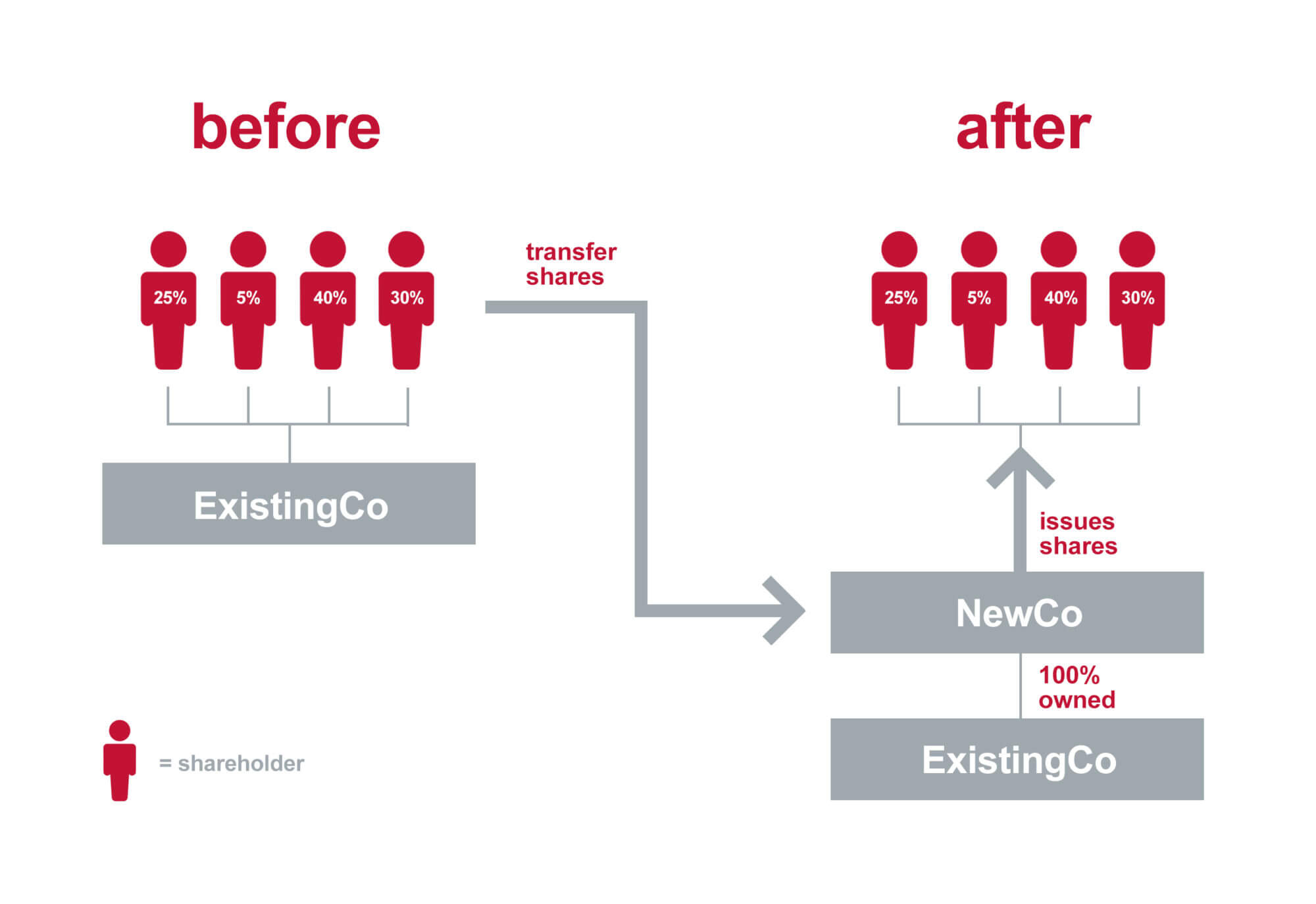
A share transfer is the simplest and most common approach. It works like this:
- you set up a new holding company in Singapore (NewCo)
- the Existing Company (ExistingCo) transfers all of the shares in ExistingCo to NewCo.
- NewCo then immediately issues shares in NewCo to mirror the holdings that had been held in ExistingCo.
Here are a few things you will need to consider if you flip via a share transfer:
- these are separate corporate transactions in two different jurisdictions. As a result, it’s a good idea to get legal and tax advice on both. For example, the share transfer may be a liquidity event in certain jurisdictions triggering a tax charge on the deemed capital gain.
- you need to attribute a value to the ExistingCo shares being transferred for the purposes of recording the share issue. This may mean you need to consider your company’s current valuation at the time of the transaction.
- although shares are being issued, no money is paid for the shares. You will need an agreement setting out the terms of this non-cash consideration. Our share exchange agreement is a useful template to record this kind of transaction. If you choose to use our share exchange agreement, you’ll need to have the agreement reviewed with local lawyers for compliance.
Overall, this is a fairly straightforward process on the Singapore side and can be done fairly efficiently with a lawyer and a corporate secretary working together, but can differ in cost and speed depending on the lawyers that you use in your home country.
option 2: asset transfer
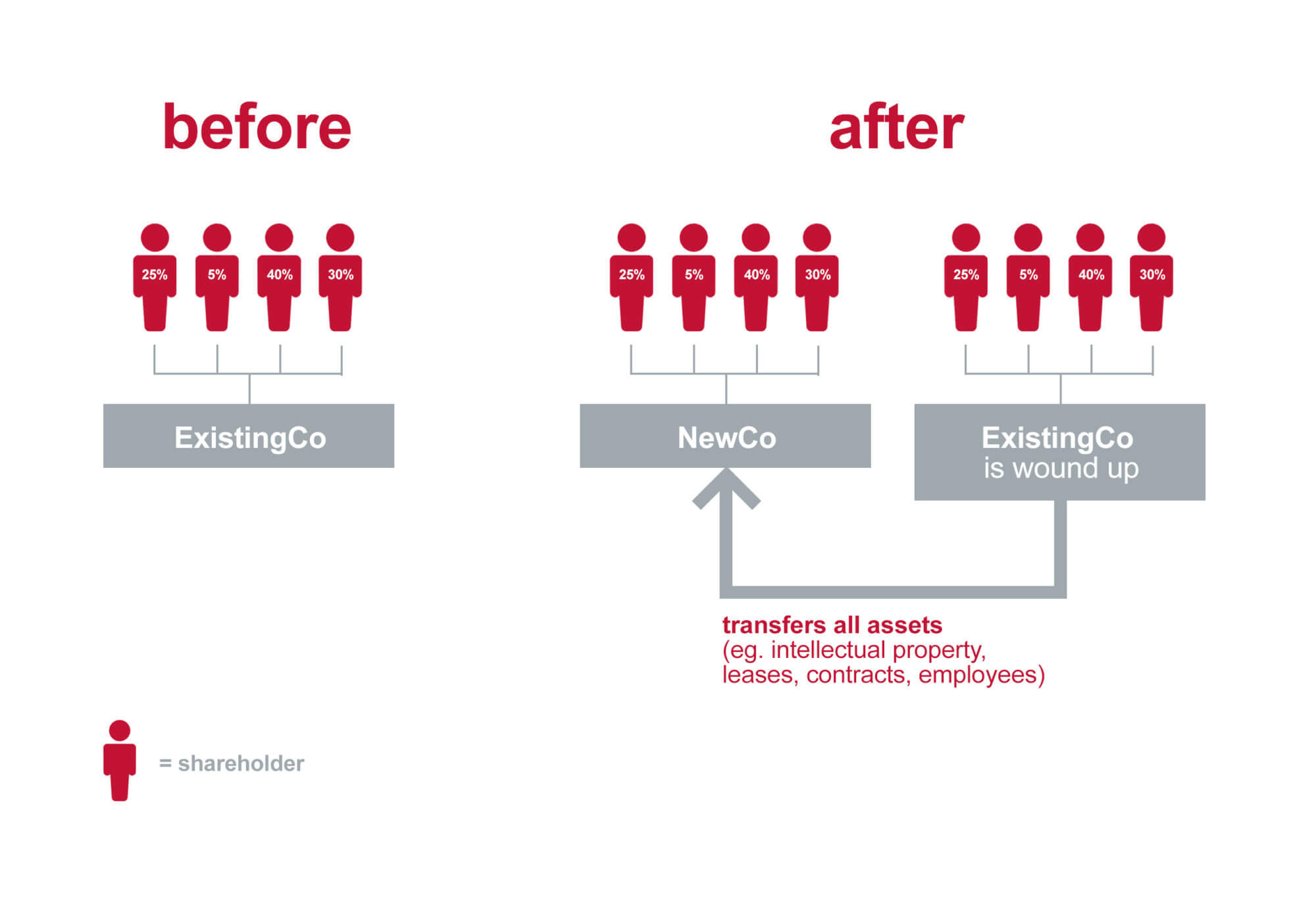
Flipping your company by way of an asset transfer is usually more complex because it requires the sale of individual assets from ExistingCo to NewCo. Given this, an asset transfer is only used if there are legal, tax or commercial issues with a share transfer.
An asset transfer involves assigning or transferring intellectual property, key assets, contracts and employees. These assignments and transfers may require the consent of third parties.
This process usually leaves ExistingCo without any assets other than either shares in NewCo or a debt from NewCo (the consideration or amount ‘paid’ for the asset transfer).
issues to watch out for when flipping your company into Singapore
- you will need to carry out some due diligence on your own company before flipping it. Aside from local legal and taxation matters, check whether existing contracts and other arrangements will be impacted by the redomicile, e.g. a shareholders’ agreement will need to be mirrored and restated under the laws of NewCo’s jurisdiction.
- the transfer of shares needs to be executed in the same way as any other share transfer, i.e with the usual stamping, approvals and registrations that are required under the applicable law. However, as no cash passes, you need to check how the transfer needs to be recorded for accounting and tax purposes.
- check any existing contracts you have. The share transfer may constitute a change of control or liquidity event under existing commercial contracts, financing documents or leases. You should review existing documents and get consent from third parties, if required.
- convertible notes issued to investors will need to be reissued by, or assigned to, the NewCo, as will any founder vesting agreements in place.
- any share option plan will need to be cancelled, restated at NewCo level, and adapted for local law and standards.
If you’d like to get more information about what’s involved with a company redomicile, speak to us.
Employee share option plans (or ESOPs) are a key tool for startups to incentivise staff and hire talent when funds are tight.
However, not all ESOPs are made the same. To make it easy, we’ve put together this guide to help you through the main commercial questions you need to consider. If you want some guidance on the process of adopting your ESOP, setting up the option pool, and granting options, read our guide on how to set up an ESOP.
1) how big should your pool of options be?
Usually an ESOP pool is around 7.5-15% of a company’s total shares on a fully diluted basis (10% is most common). If you are setting up an ESOP as part of a capital raising transaction, your incoming investors may have specific requirements around this.
Generally speaking, founders are expected to take on the dilution from setting up an ESOP pool, and investors are not (i.e. an investor’s agreed stake in the company is calculated on a fully diluted basis, taking the ESOP pool into account even if the ESOP has not been formally put in place yet).
This means it’s important to make sure your ESOP pool is not significantly larger than required for your foreseeable hiring needs, as that chunk of equity comes out of your own pocket as a founder. Conversely, you’ll generally want to make sure you’ve set up a big enough pool to attract and retain the talent you’ll need.
2) how much will it cost employees to exercise their options?
The exercise price is the price that an employee must pay to exercise their options and is decided on a case-by-case basis for each employee. The exercise price is often set at the market price of the company’s shares at the time the options are granted (usually determined by reference to the latest completed funding round). Employees then benefit as the value of the company increases from the date they received their options.
3) how long will employees have to exercise their options?
The expiry date of an option is the latest date by which the option holder can exercise that option. This is typically aligned with the expected time frame for the company to find an exit. Typically in Southeast Asia this will be 7-10 years from the date of grant, but of course this depends on your company’s stage and maturity.
The expiry date may change if an employee ceases to work for the company. The most employee-friendly ESOPs do not change the expiry date if any employee leaves. Leavers are therefore not forced into exercising options prior to an exit event. However, some companies prefer to give leavers a shorter time frame, for example up to one year after leaving the company to exercise any vested options. This lowers the company’s administrative burden of keeping track of departed employees who hold options.
4) what is the timetable for the options to vest?
Options almost always vest over a 3 or 4-year period. Vesting incentivises employees to stay with the company throughout the vesting period, in order to be able to exercise all of their options in the future. Generally, if an option holder leaves before the end of the vesting period, he or she will lose their unvested shares.
Our template ESOP rules allow for recipients to have personalised vesting schedules on a case-by-case basis. Shorter vesting periods may be appropriate for employees who have already worked for the company for a significant period of time prior to receiving options.
5) what happens at an exit event?
This is likely to be the part of your ESOP which requires the most thought.
Our template rules provide for single-trigger acceleration on an exit; that is, all unvested options vest on an exit event and can be exercised in full. Single trigger acceleration is the most employee-friendly position and encourages all parties to push for an exit as soon as possible.
However, potential acquirers of your company can be put off by single trigger acceleration, as they often want key employees to stay with the business after the acquisition (and the continued vesting of options encourages that). Some companies therefore prefer double trigger acceleration in order to make their company as attractive an acquisition target as possible.
We find there is a lot of variation in Southeast Asia on this point. Single trigger remains the most common, as compared to the US, where double trigger acceleration is more usual.
The different scenarios are summarised below:
| no acceleration
| None of the unvested options vest on an exit event, and any unvested options expire. Option holders can only exercise options which have vested. |
| partial acceleration
| A set percentage of the unvested options vest on an exit event. The remaining options continue to vest in accordance with the vesting schedule. This can be important to a buyer where employees remain employed by the surviving entity, so that they continue to work for the business and earn their options. However, it can be less appealing to employees, who will lose unvested options even if they are terminated without cause. |
| double trigger acceleration
| A set percentage of the unvested options vest on an exit event. The remaining options vest on a second trigger, e.g. the employee being terminated (or resigns with good reason) in connection with, and within a certain time after, the exit event. That way, if the second trigger event does not occur, the employee must stay with the company in order to earn their remaining unvested shares. However, if a buyer does not choose to keep an employee after an exit, the employee is not penalised for this. In Southeast Asia, we do not see double trigger acceleration very often but expect that to change as some of the larger tech companies adopt Silicon Valley practices. |
Despite ESOPs being a common feature of many startups in Southeast Asia, their implementation can vary according to founder and investor needs. If you would like to discuss drafting an ESOP for your own startup, you can contact us.
free startup document makers
read our startup case studies

Southeast Asia’s online-to-offline (O2O) space is hot. Platforms linking online customers with offline services are now part and parcel of daily life, from the likes of well-backed Go-Jek and Grab, to Fave – one of the region’s most exciting new O2O companies.
Fave started out in 2015 as a fitness sharing platform called KFit before stepping into multi-category local commerce with the launch of Fave. The company is connecting millions of customers with thousands of local service businesses including restaurants, cafes, salons, spas, hotels, gyms and more.
Founder and CEO, Joel Neoh, talked to us about their journey and how they have found working with Kindrik Partners.
the Fave story
Fave’s founders Joel Neoh and Yeoh Chen Chow are no strangers to O2O local commerce. Joel started Groupsmore, a daily deals site that was acquired by Groupon in 2011. Joel went on to head up Groupon’s business in APAC, alongside Chen Chow, who led Groupon’s regional operations.
Spotting an opportunity to disrupt the fitness business in APAC, Joel left Groupon to start KFit, the region’s first-ever fitness sharing platform, touted as an Uber style platform for gyms and fitness studios.
After a year of tremendous growth and raising a US$12m series A financing, the company set its sights beyond the fitness space and launched its multi-category platform. It went on to acquire Groupon’s businesses in Indonesia, Malaysia and Singapore.
According to Joel, the pivot to a broader O2O platform was a natural progression for the company, as multi-category local commerce presented a much larger business opportunity. Joel observed that apps with high-frequency use cases tend to succeed in a competitive landscape. Fave was launched with a focus on the food and drink category – a major part of life in Southeast Asia.
Whilst deals businesses have been around for a while, Fave is focused on merchant-first innovation via deeper product development and data science. All with a view to enhancing the customer experience with daily deals and rewards. Joel notes that the traditional deals model only brings in new customers to offline businesses and stops there. To truly add value to local businesses, Fave wants to create an ecosystem where businesses can acquire, retain and re-target customers in the online world.
working with kindrik partners
Lee Bagshaw started working with Joel from the set-up of what was the KFit business in 2015. As well as advising Fave on its VC financing rounds, Lee and Chris Wilson have helped Fave on the three M&A deals relating to the acquisitions of Groupon’s Indonesian, Malaysian and Singaporean businesses.
Joel says that Kindrik Partners provided insightful and comprehensive legal advice that played a key role in helping Fave reach some major milestones. He specifically notes Kindrik Partners team’s considerable expertise in VC and tech M&A, which helped the company efficiently navigate the documentation negotiating during its funding rounds and the Groupon transactions.
The future of O2O commerce in Asia looks bright in Southeast Asia as new generation of digitally savvy consumers come online. Kindrik Partners looks forward to helping Fave continue its rapid journey to become a leading O2O player in the region.
Explore Fave.
[Note: The firm’s name was changed to Kindrik Partners in July 2020 and references to the firm’s previous name have been updated.]

Fintech startups are the next big thing in the Southeast Asian tech scene. Kindrik Partners client C88 (formerly Compare88) is racing ahead of the pack after securing the backing of high-profile VC investors including Telstra Ventures.
C88 provides online financial services price comparison tools, helping consumers to compare the offers of major brands for products such as credit cards, personal loans, mortgages, vehicle loans, savings accounts and insurance. The company also offers a brokerage service, enabling consumers to purchase products directly on the C88 platform – for which C88 has secured relevant financial services licences through Southeast Asia.
Founder and CEO, J.P. Ellis, talked to us about the company’s background, its most recent series B financing round, and how they have found working with Kindrik Partners.
the c88 story
Prior to C88, founders Karl Knoflach and J.P. worked in private equity, finance, operations and leadership. The C88 senior team also consists of Gary Empl, a professional software developer with over two decades of experience leading teams in the creation of cutting-edge software in the financial services industry. Karl and Gary were part of the original founding team of einsurance.de in Munich in 1999 – a revolutionary company in the German insurance space which later became Check24.de, the German market-leader.
C88’s commercial teams in Indonesia, the Philippines and other markets are made up of senior bankers, insurance executives and sales operators with many years of experience in financial products sales and distribution. This experience, and the networks that senior team members bring, is crucial to C88 maintaining its market leader position.
J.P. notes that the Southeast Asian economy’s migration to digital begin with communities moving online for social needs. This was followed by online purchasing of physical goods, usually electronics and clothes, then travel bookings, followed more recently by financial services. This migration began in earnest in 2009, and by 2011 there were already major e-commerce providers. Online channel emerged in the insurance vertical in 2013, and C88 followed quickly releasing its platform in 2014.
J.P. observes that high traffic digital marketplaces, such as C88’s CekAja.com brand in Indonesia and eCompareMo.com brand in the Philippines, benefit consumers as well as underwriters. C88 can use its volume to create pricing efficiency for their customers. That volume also reduces the overall cost of acquisition for underwriters. Prior to the emergence of financial services e-commerce, banks and insurers basically only had two options for sales in the large markets of Southeast Asia: branches or physical agents. Digital sales through C88’s platform provides a highly cost-effective alternative.
challenges
Southeast Asia remains highly fragmented. Operating a multi-jurisdictional structure that is attractive to both consumers and providers, while keeping national regulators on-side, is challenging.
The company also faces the challenge of creating a common culture across national teams. Incentivising teams in different verticals and across countries to work together to solve problems creatively is an ever-evolving process of creative leadership and problem solving.
J.P adds that fortunately, C88’s team are multi-lingual and truly love what they do. It is not at all uncommon for them to log long hours during the week and weekends, because they genuinely enjoy what they do in building systems and solving problems for consumers in the region.
working with Kindrik Partners
As well as advising C88 on its venture capital financing rounds, Kindrik Partners’s Lee Bagshaw and Chris Wilson have helped C88 implement a variety of business critical structures including inter-company, cross-border licensing agreements and intellectual property documentation.
J.P says that Kindrik Partners provided high-quality and competitively-priced legal services in the critical areas of C88’s business. J.P. particularly appreciated the level of support he received when negotiating and completing the company’s recent Series B round led by Telstra Ventures – he says that the Kindrik Partners team know venture capital deals inside out, and made the negotiation of the financing documentation a breeze.
Kindrik Partners looks forward to helping C88 to continue its journey to become a leading fintech player in Southeast Asia and beyond.
Explore C88.
[Note: The firm’s name was changed to Kindrik Partners in July 2020 and references to the firm’s previous name have been updated.]

Singapore-based Pixibo provides personalised size and fit recommendations in real time for online retailers and their customers. The fashion-tech startup worked with Kindrik Partners on their recent series A raise.
We spoke to founder and CEO Rohit Kumar on Pixibo, the capital raising journey, and working with Kindrik Partners.
pixibo’s story
Rohit is an ex-Googler with experience across Europe and India, before heading to Singapore to head up operations for e-commerce advertising company Sociomantic. Between 2013 and early 2016 he launched and managed all of Sociomantic’s APAC operations and was part of the team that sold the business to dunnhumby, a Tesco company.
It was at Sociomantic that Rohit identified an issue plaguing fashion e-commerce sites. People were browsing clothes online, but very few of those visits converted into sales. “The average conversion rate is 1.5%”, says Rohit.
Pixibo’s technology was formally launched in 2018, after a few years in development. The platform makes real-time size recommendations, personalised for every shopper and for every brand and SKU. For a retailer this boosts conversion rates, reduces return rate and improves customer satisfaction. Its size recommendation engine is entirely white labelled and can be natively integrated into online stores.
“In online shopping, there’s a lot of pain points, from finding something you like, to working out which size is correct for you,” says Rohit.
“Decision fatigue can come in, reducing sales and resulting in increased return rates. The Pixibo platform works to reduce the friction felt by the consumer and the retailer.”
working with kindrik partners
“I was educating myself about series A rounds when I came across Kindrik Partners’s content online,” Rohit says.
“It was my first time doing an institutional round so I was spending more time online trying to get my head around the legal terminology and the types of things that show up. Drag alongs, tag alongs, liquidation preference clauses. There’s a lot to understand.”
(confused? see our startup glossary )
“It looked like Kindrik Partners were the best lawyers for startups,” says Rohit.
“It was clear from the content that was available online that it was their area of expertise. When I eventually needed to bring in a lawyer to help with my round, I reached out.”
on the series A round
Pixibo already had several angel investors prior to their series A round in 2018, but the startup did not have any VCs on board, so the experience was new.
“We had VPs from Google who invested at an early stage, as well as strong private angel investors. But this was the first institutional round, and it felt very different.”
A big learning was how much longer the process took. “I thought you’d just go out to market, pitch, and then get them to sign. I eventually came to understand the level of process that institutional investors require, and how this stretches out the timeline.”
“There’s a great level of detail required. From investor interest to the term sheet to drafting the shareholder’s agreement, share subscription agreement and the whole nine yards, to signing, to getting money in the bank… it can take a long time!”
Fortunately, runway was less of a concern for Pixibo. “We weren’t in a rush. We had revenue, so there was no immediate need to get funding in”, says Rohit. “We already had a recurring revenue from our licence fees we were charging. That started conversations for us with investors, too.”
working with kindrik partners
Rohit found working with Kindrik Partners and partner Lee Bagshaw provided a lot of value during the capital raising process.
“Working with Lee was great. He was very responsive to my requests and concerns and was always happy to get on a call if need be to walk through things with me.”
Kindrik Partners’s experience in capital raising in Southeast Asia was also an asset to Pixibo.
“As a first time founder, sometimes you’re like wait, hang on, why is that in there? Lee was invaluable in these situations. He understood what terms were negotiable and what terms weren’t, and was instrumental during all of the back and forth with investors.”
tips for founders embarking on their A round
Rohit has a few tips for those entrepreneurs who are considering going out to do their series A round.
- start out 6 -8 months before you need the capital: especially if it’s your first institutional round (it gets easier with a follow-on round, because you’ll have existing investors to help you get your foot in the door).
- consider a rolling close: since you’re looking for investors who are the right fit in a long-term partnership, having a rolling close allowed Pixibo to get the money in the bank from the investors who were committed, while continuing to find the perfect fit to close out our round.
- beware the temptation to think that any money will do: in the beginning, the temptation is to look for anyone with a cheque book, but then you get smarter. Find the VC’s thesis and their sweet spot, and get smarter at looking at their portfolio to see if you fit in. Who will be interested in your story?
- don’t raise too soon: Traction is important. Wait until you’re in a strong position to raise, if you can. In our case, as we’re B2B, we had clear proof points that our product works, solves a real problem for online retailers and that they are willing to pay us for it. Investors will want to see that you have put in the hard work and that capital will accelerate growth.
- have a plan for the money. You have to articulate why you need capital now, and how it will help your business.
what’s to come for pixibo
The future is bright for Pixibo, and Rohit is looking ahead to expand into new markets. “The most exciting thing about us is that we’re location agnostic. The problems retailers have in Singapore are the same ones that they have in Sydney. The opportunity is massive.”
[Note: The firm’s name was changed to Kindrik Partners in July 2020 and references to the firm’s previous name have been updated.]
