free tech m&a resources
Explore our collection of resources for your upcoming merger, acquisition, or exit in Southeast Asia.

templates
Browse our free m&a templates and get familiar with disclosure letters, term sheets, and more.

This agreement is for use when a company primarily wishes to bring in employees from a target company, rather than acquiring its business. Acqui-hires are common amongst well-funded startups looking to expand their teams by hiring talent from other startups. Often the employees are acqui-hired from businesses that are failing and are subsequently shut down.
This agreement covers the transfer of the employees and release of any existing restraints, together with a general assignment of intellectual property rights. It sets out the terms of payment of the acquisition amount – this is sometimes paid in tranches and adjusted if the transferring employees subsequently move on soon after completion of the acqui-hire.
using our templates
Use of a template by business users is free of charge and is subject to you agreeing to our template terms of use.
This is a template disclosure letter for disclosing against warranties provided in an M&A or capital raising transaction.
read our guide: tricky clauses: warranty disclosures (4 minute read)
read our guide: raising seed capital in southeast asia (8 minute read)
Typically under these transactions, a company (and, in some cases, its founders) provides statements to a purchaser or investor in the transaction documents. If any of these statements (known as warranties) turn out to be untrue, the purchaser or investor can bring a claim for a breach and potentially recover money from the parties that gave the warranties.
A disclosure letter protects warrantors, by allowing them to disclose any matters that are inconsistent with the warranties set out in the transaction documents. The purchaser or investor cannot bring a warranty claim in respect of matters which have been fairly disclosed. The disclosure letter is the document which formally records these disclosed exceptions to the warranties. It is therefore an integral part of the transaction documents and the earlier warrantors start preparing the document on any transaction, the better.
using our templates
Use of a template by business users is free of charge and is subject to you agreeing to our template terms of use.
This Due Diligence Document List is a list of legal documents for review by potential purchasers of the shares or assets of a target company in a private M&A transaction. In the course of the purchaser’s due diligence investigations, additional questions will inevitably arise, but this list is a good starting point.
using our templates
Use of a template by business users is free of charge and is subject to you agreeing to our template terms of use.
This is a template term sheet for use when one tech company is acquiring the shares of another tech company. It sets out the principal terms agreed between the acquiring company and the shareholders of the target company prior to preparing the formal sale and purchase agreement. The acquisition of a competing and/or complementary business in this manner is a common strategy of well-funded high growth technology companies.
This term sheet assumes that the transaction will be structured as a share sale (as is most common). It should not be used in connection with an acquisition of the business and assets of a target company. This term sheet is not legally binding (other than the confidentiality obligations in part B); it simply sets out the terms agreed in relation to the acquisition.
using our templates
Use of a template by business users is free of charge and is subject to you agreeing to our template terms of use.
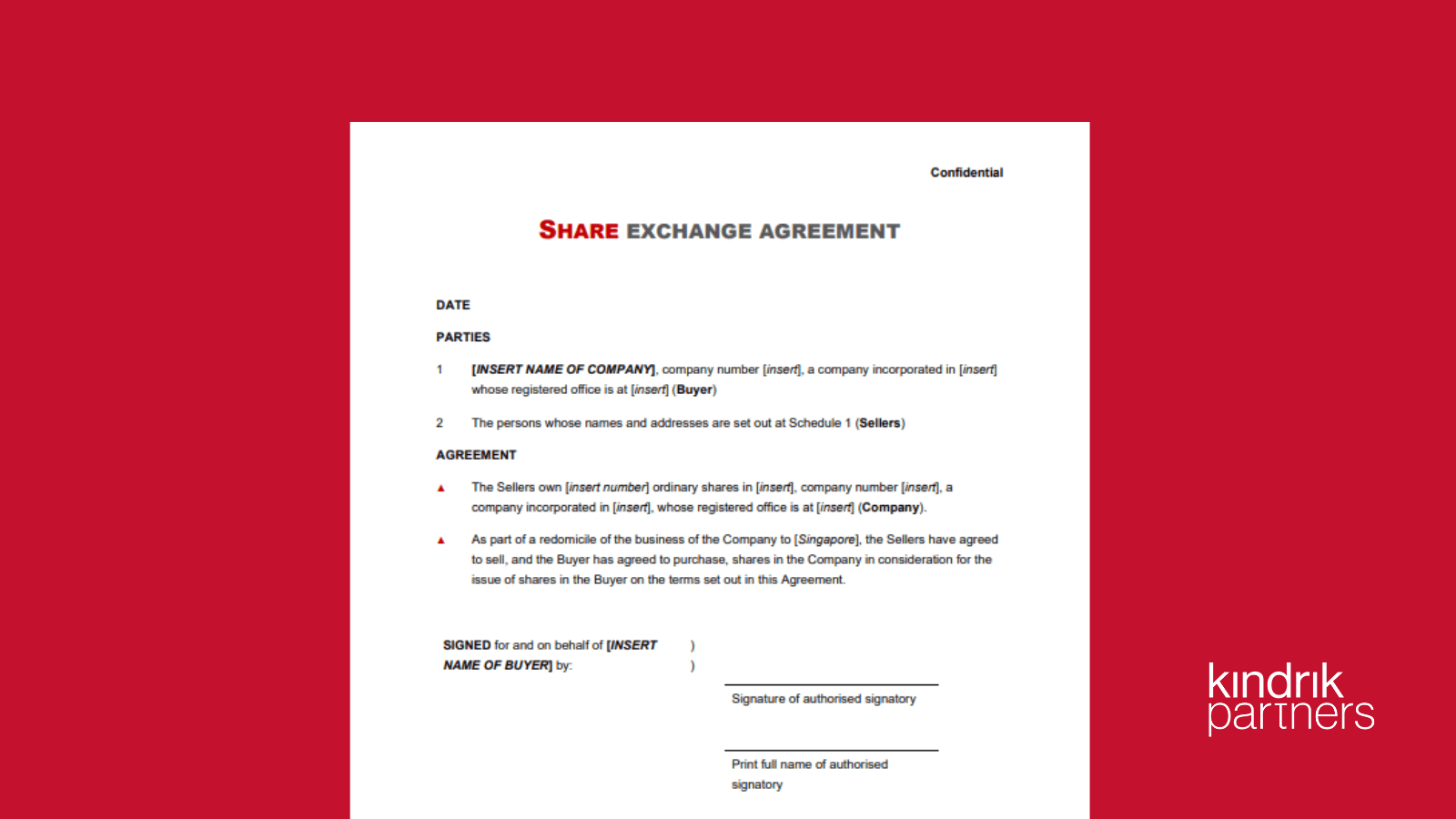
This agreement is for use by Southeast Asian companies looking to redomicile or flip to Singapore. Our experience is that, with a few exceptions, most Southeast Asian tech startups wishing to raise capital from professional investors end up being domiciled in Singapore (either to attract investment or as a requirement of their investors).
Flipping to a new jurisdiction can be done in two ways: either by a transfer of shares or by a transfer of assets. Please see our guides to raising seed capital in southeast asia for more information on the different processes involved. This agreement is for the first option – where the shares in your existing company are transferred to a newly incorporated Singapore company. That new company then issues shares to the shareholders of the existing company in equal proportions. These are separate corporate transactions in two different jurisdictions requiring legal and tax advice in each of those jurisdictions.
using our templates
Use of a template by business users is free of charge and is subject to you agreeing to our template terms of use.
explore our case studies

about X0PA.AI
Singapore-based X0PA.AI is a SaaS talent hiring and recruitment platform that uses AI and data science to match applicants to roles, as well as predict issues such as attrition, loyalty and performance.
CEO Nina Suri has scaled the team over three years to twenty-five employees, located across Singapore, India, and the UK, with plans to start in the UAE.
X0PA recently implemented an employee share option plan (ESOP) and Nina shared her experience.
why implement an ESOP
“Having had over twenty years of entrepreneurship, I knew I wanted to build a culture of ownership and inclusivity, and ensure that our team felt involved and satisfied”, says Nina.
“An ESOP is one way that our employees can feel like they’re a part of growing something – that our success is their success”, says Nina.
putting the ESOP in place
The company originally drafted some ESOP paperwork when they first incorporated, but as they grew, X0PA’s company secretary recommended that it be replaced with something more robust and market standard.
“We learned that the ESOP needed major amendments in order to be more in line with what is typically seen in the market in Singapore, and reflect what investors are likely to expect”, said Nina.
Nina reached out Kindrik Partners after the firm was recommended to them by their company secretary. XOPA worked with Sarah Yen in Kindrik Partners’s Singapore office, who was able to create the right framework for the startup.
“We were looking for a firm who advised a lot of startups in Southeast Asia. Sarah took the time to explain and really make sure that we understood the mechanics of how the ESOP operated. This made it easier for us to communicate that to our employees.”
“It’s important when putting together an ESOP to consider several different factors”, says Sarah. “What works for the company, what is standard in the market to attract quality talent, and what your investors and most importantly a future potential buyer might expect to see.”
about the ESOP
A X0PA employee is invited to participate in the ESOP once they have been with the team for twelve months, and if they’re considered a ‘high performer’.
“At the moment we have a rockstar team, and 100% of the people who we have hired have been invited to join”, says Nina.
“In my previous venture I also felt strongly about letting my employees be directly involved – but I gave them straight equity. It was a more traditional business with a partnership model.”
“This time, an ESOP seemed more appropriate – it was a more scalable model and more appropriate for the type of company we wanted to build.”
X0PA’s management team put aside 10% of the company’s equity towards the ESOP, with the expectation that this allocation would last at least five years. They set the exercise price by the valuation of the company at the time of allocation.
Allocations were not standardised per employee but were allocated according to the contribution and importance’ of the employee’s role in the organisation, according to Nina.
The X0PA team also included an acceleration clause in the ESOP – if the company exits before the vesting period, their employee’s options fully vest.
advice for other founders
“We weren’t familiar with the nitty gritty of putting in place an ESOP – it was a new experience for us”, says Nina.
“My advice would be to go with a lawyer who is experienced with startups and ESOPs, so you don’t have to go through the complications that we went through as we started to scale”, she says.
Nina also stressed that it was important to familiarise yourself with the mechanics of your startup’s ESOP so that management could communicate with staff effectively about how it worked.
Nina also had some tips about how to communicate with a team when implementing an ESOP.
“We kept it very simple for our staff. We broke down into the main points – what is the ESOP, what does it mean for them, what do they get, how much do they get. We didn’t want to get them worked up about the legal language.”
Nina also made sure that she sent each team member an individual email after the scheme was introduced to the company, confirming what the ESOP meant, how that individual’s options vested, and what would happen to their options in different scenarios.
“You need to make sure your team understands what the ESOP is. If you’re giving them something, and they don’t appreciate it, and then what’s the point? It’s best to spell it out and make sure that everyone understands – then you’re all working towards a common purpose.”
what’s next for X0PA?
“We’re starting to move from startup to scale up now. We’re experiencing massive acceleration and growth, with several Government departments, enterprises, polytechnics and universities as clients”, says Nina.
“Our product is ready, and strong, and we’re ready to grow and help our clients with their digital transformation. We are focused on growth both from increasing market share in the markets we operate in as well as market expansion point of view.”
[Note: The firm’s name was changed to Kindrik Partners in July 2020 and references to the firm’s previous name have been updated.]
Explore our other case studies here, or access our full library of ESOP guides and templates via our resources section.

Singapore company CardUp is an online platform that lets individuals and SMEs pay for expenses like taxes, rent, or even payroll, using their credit card – even if the recipient doesn’t accept cards.
Cardup raised a seed round lead by top tier venture firm Sequoia Capital in late 2017. We spoke to founder Nicki Ramsay about Cardup’s journey so far.
story
Nicki got the idea for CardUp while working at a major credit card provider in Singapore. She saw that a lot of big ticket items (like tax and rent) could not be paid for with a credit card, because the recipients were not willing to go through the hassle and fees associated with the setup process. This meant that card holders were not getting benefits from these big payments such as being able to access their credit facility or earn loyalty reward points. In addition, banks were losing out on the fees that would be linked to an increase in credit card spending.
CardUp solves this by flipping the existing card processing model, acting as the middleman between cardholders that want to use their card in more ways and recipients who don’t accept card payments. CardUp users benefit from using the credit line on their card to extend the payables period for these expenses, as well as earning credit card loyalty points and rewards. In addition, the recipient does not need to have a CardUp account to receive credit card payments.
Finding the initial capital and relevant expertise needed to get a company off the ground is a challenge for a lot of the founders that we work with. This is particularly common for solo founders like Nicki, as they are not able to draw on the financial resources and connections of their co-founders. In Nicki’s case, she decided to join The Finlab (United Overseas Bank’s Singapore fintech accelerator), which was a great way to access mentorship and exposure to a wide investor community.
While at The Finlab, Nicki spent a lot of time talking to financial institutions, to get them on board with cardholders using the platform. CardUp has since secured partnerships with many of Singapore’s major banks to promote CardUp’s services. The company also promoted the platform to individuals and SMEs through its online marketing content. The focus of this material was to educate users on the platform’s benefits and how the platform works.
the financing deal
As CardUp gained more users, the company needed to raise some money to further develop its platform.
Nicki pitched to a wide range of VCs in Southeast Asia. Sequoia was a natural fit as they are deep in the payments space, and CardUp is disrupting traditional payment processing models.
Other investors included SeedPlus, who were originally introduced to Cardup by The Finlab.
The company completed its ~US$1.7m seed round in late 2017. The investment has allowed the company to triple the size of its team in just a few months.
working with us
Nicki told us that Kindrik Partners’ depth of knowledge on VC deals in Southeast Asia was a massive help throughout the capital raising process:
Kindrik Partners added a lot of value for us during the negotiation with Sequoia as they have vast experience with startup and VC deals in the region and are very familiar with the different permutations of VC term sheets. Also, because they have acted for a lot of startups taking investment from Sequoia, they saved us time and cost by telling us which points Sequoia would likely be open to negotiating.
Overall, Nicki said that the Kindrik Partners team were extremely knowledgeable, and professional to deal with.
Having worked with Nicki, we are now certain that it won’t be long before everyone will be using their credit card for important payments, like their legal fees!
Explore CardUp.
[Note: The firm’s name was changed to Kindrik Partners in July 2020 and references to the firm’s previous name have been updated.]

Singapore-based Pixibo provides personalised size and fit recommendations in real time for online retailers and their customers. The fashion-tech startup worked with Kindrik Partners on their recent series A raise.
We spoke to founder and CEO Rohit Kumar on Pixibo, the capital raising journey, and working with Kindrik Partners.
pixibo’s story
Rohit is an ex-Googler with experience across Europe and India, before heading to Singapore to head up operations for e-commerce advertising company Sociomantic. Between 2013 and early 2016 he launched and managed all of Sociomantic’s APAC operations and was part of the team that sold the business to dunnhumby, a Tesco company.
It was at Sociomantic that Rohit identified an issue plaguing fashion e-commerce sites. People were browsing clothes online, but very few of those visits converted into sales. “The average conversion rate is 1.5%”, says Rohit.
Pixibo’s technology was formally launched in 2018, after a few years in development. The platform makes real-time size recommendations, personalised for every shopper and for every brand and SKU. For a retailer this boosts conversion rates, reduces return rate and improves customer satisfaction. Its size recommendation engine is entirely white labelled and can be natively integrated into online stores.
“In online shopping, there’s a lot of pain points, from finding something you like, to working out which size is correct for you,” says Rohit.
“Decision fatigue can come in, reducing sales and resulting in increased return rates. The Pixibo platform works to reduce the friction felt by the consumer and the retailer.”
working with kindrik partners
“I was educating myself about series A rounds when I came across Kindrik Partners’s content online,” Rohit says.
“It was my first time doing an institutional round so I was spending more time online trying to get my head around the legal terminology and the types of things that show up. Drag alongs, tag alongs, liquidation preference clauses. There’s a lot to understand.”
(confused? see our startup glossary )
“It looked like Kindrik Partners were the best lawyers for startups,” says Rohit.
“It was clear from the content that was available online that it was their area of expertise. When I eventually needed to bring in a lawyer to help with my round, I reached out.”
on the series A round
Pixibo already had several angel investors prior to their series A round in 2018, but the startup did not have any VCs on board, so the experience was new.
“We had VPs from Google who invested at an early stage, as well as strong private angel investors. But this was the first institutional round, and it felt very different.”
A big learning was how much longer the process took. “I thought you’d just go out to market, pitch, and then get them to sign. I eventually came to understand the level of process that institutional investors require, and how this stretches out the timeline.”
“There’s a great level of detail required. From investor interest to the term sheet to drafting the shareholder’s agreement, share subscription agreement and the whole nine yards, to signing, to getting money in the bank… it can take a long time!”
Fortunately, runway was less of a concern for Pixibo. “We weren’t in a rush. We had revenue, so there was no immediate need to get funding in”, says Rohit. “We already had a recurring revenue from our licence fees we were charging. That started conversations for us with investors, too.”
working with kindrik partners
Rohit found working with Kindrik Partners and partner Lee Bagshaw provided a lot of value during the capital raising process.
“Working with Lee was great. He was very responsive to my requests and concerns and was always happy to get on a call if need be to walk through things with me.”
Kindrik Partners’s experience in capital raising in Southeast Asia was also an asset to Pixibo.
“As a first time founder, sometimes you’re like wait, hang on, why is that in there? Lee was invaluable in these situations. He understood what terms were negotiable and what terms weren’t, and was instrumental during all of the back and forth with investors.”
tips for founders embarking on their A round
Rohit has a few tips for those entrepreneurs who are considering going out to do their series A round.
- start out 6 -8 months before you need the capital: especially if it’s your first institutional round (it gets easier with a follow-on round, because you’ll have existing investors to help you get your foot in the door).
- consider a rolling close: since you’re looking for investors who are the right fit in a long-term partnership, having a rolling close allowed Pixibo to get the money in the bank from the investors who were committed, while continuing to find the perfect fit to close out our round.
- beware the temptation to think that any money will do: in the beginning, the temptation is to look for anyone with a cheque book, but then you get smarter. Find the VC’s thesis and their sweet spot, and get smarter at looking at their portfolio to see if you fit in. Who will be interested in your story?
- don’t raise too soon: Traction is important. Wait until you’re in a strong position to raise, if you can. In our case, as we’re B2B, we had clear proof points that our product works, solves a real problem for online retailers and that they are willing to pay us for it. Investors will want to see that you have put in the hard work and that capital will accelerate growth.
- have a plan for the money. You have to articulate why you need capital now, and how it will help your business.
what’s to come for pixibo
The future is bright for Pixibo, and Rohit is looking ahead to expand into new markets. “The most exciting thing about us is that we’re location agnostic. The problems retailers have in Singapore are the same ones that they have in Sydney. The opportunity is massive.”
[Note: The firm’s name was changed to Kindrik Partners in July 2020 and references to the firm’s previous name have been updated.]
